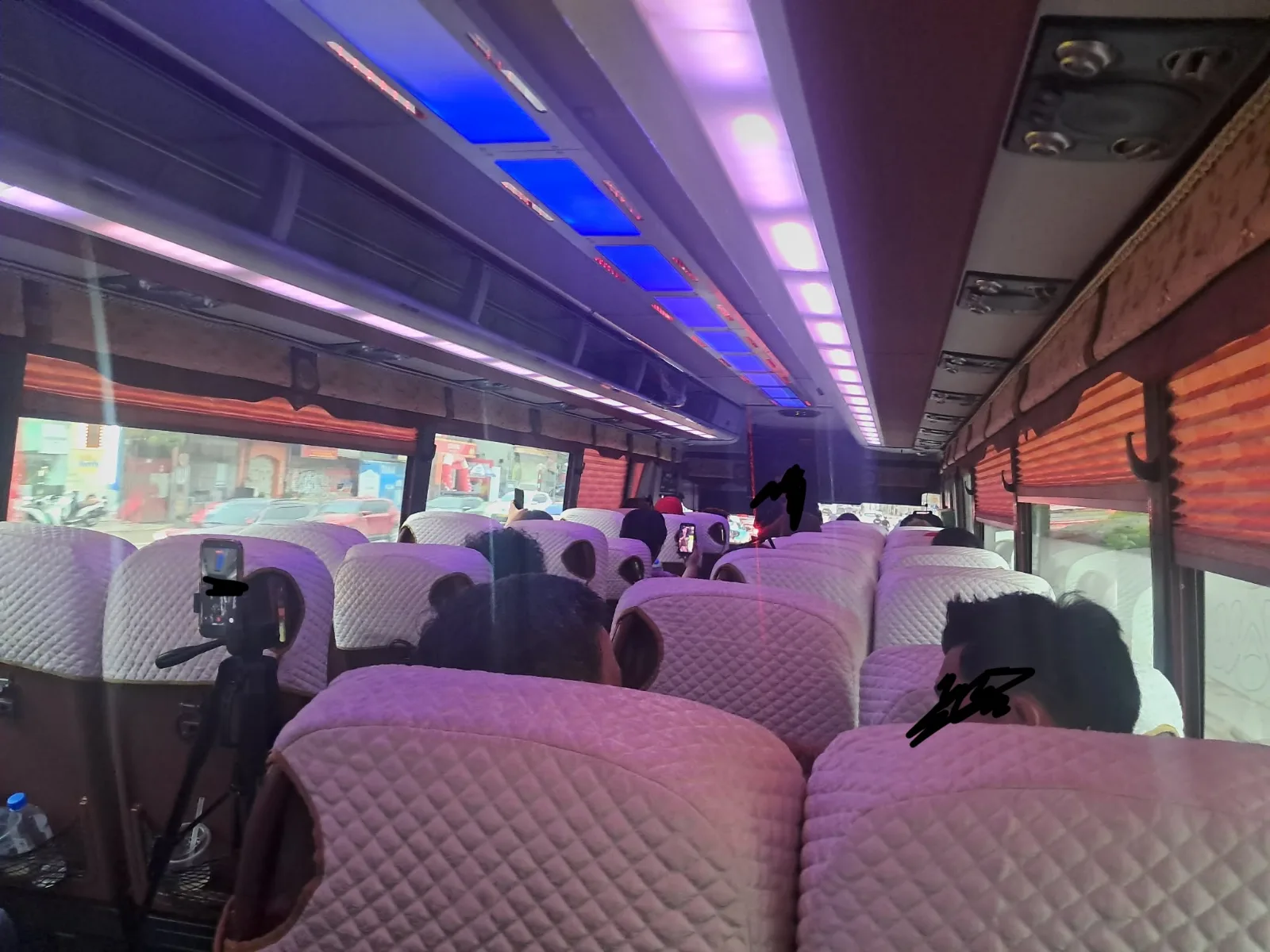
It was our last night in Vietnam. We had just finished dinner, and our bus was making its way to the airport for a 40-minute ride that would end our trip. Everyone on board was full, tired, and rushing through the mental checklist that comes before a flight — passports, luggage, did I leave anything at the hotel.
I was seated near the back, second or third row from the last. It wasn't planned. It was just where I ended up sitting, the kind of small detail you don't think twice about until it becomes part of a story you replay in your head for weeks afterward.
Our tour guide started singing to lift the mood — a common thing tour guides do to send tourists off with some warmth. People in the group loved it. "More, more," they kept saying, and cash started coming out — tips, appreciation, the usual exchange of a good trip well spent. He sang again. More money came his way.
And then he said something, half-joking, that I have not been able to shake since: "Oh my God, I am being so capitalism right now."
Nobody else on the bus reacted to it. Most people probably didn't catch what he meant, or didn't think about it long enough to notice. But I did. Here was a man, casually and jokingly, describing an entire economic and political concept — using it accurately, using it comfortably — in the middle of what was, for everyone else, just a fun moment on a bus.
I couldn't stop thinking about it. Not because the joke was clever. But because of how effortlessly he made it.
Rewinding to Day One
That moment didn't come out of nowhere. It connected to something that happened on our very first day in Vietnam — a conversation I had almost forgotten until the bus ride brought it rushing back.
On day one, the same tour guide explained to us why Vietnam's currency carries such large denominations — 50,000 dong, 100,000 dong, even a million dong, exchanging to roughly 2,500 pesos or so. He walked us through it without hesitation: the economic collapse that followed the fall of the Soviet Union, how communist economies like Vietnam, Poland, and China were hit by the same wave of instability, and how that history directly shaped the inflation and currency structure Vietnam still carries today.
Then he said something that stuck with me even more: Vietnam right now is a socialist country. Not communist — socialist. He explained the distinction with a kind of ease that surprised me: certain industries are reserved exclusively for government control and cannot be touched by private entities, while everything else — restaurants, private companies, even electric vehicle brands like VinFast — operates under capitalism. A hybrid system, and he understood exactly where the line was drawn.
I remember genuinely being curious, because the Philippines and Vietnam sit on completely different ends of this spectrum — we are a capitalist country, and Vietnam, as he described it, is something else entirely.
So during lunch after visiting the Vietnam-US War Museum, I found him again and asked directly, in English: "You said Vietnam right now is a socialist country. But why can I still see the communist symbol everywhere?"
I had noticed it throughout the trip — every Vietnamese flag seemed to be paired with the communist emblem beside it.
His answer was immediate, no hesitation: "Even though we are a socialist country, we are still governed by a communist party."
The economic system is socialist. The governing party is communist. Two different layers, and he could explain both without missing a beat — the same way someone might explain how their own family operates.
I asked him more — about corruption, specifically, because as a Filipino, corruption is a wound we know intimately. He said corruption exists everywhere, but that Vietnam, in his view, is improving over time. I wanted to go deeper into that conversation, but a language barrier got in the way before I could really unpack it with him.
The Realization That Hit Me on That Last Bus Ride
Fast forward back to that final night — the joke, the singing, the tips, "I am being so capitalism right now" — and everything from day one came rushing back into focus.
Why was this so easy for him? Why could he speak about his own country's government structure — its economics, its history, its contradictions — with the same casualness most people reserve for small talk?
And then, the harder question: why can't we do that back home?
Here's what I've come to believe is the real difference. In the Philippines right now, our political conversations rarely reach the level of structure at all. We don't talk about government mechanics, policy, or what's actually broken and why. Instead, what gets argued over is color — DDS, Pink, Kakampink, Liberalista, or whatever label happens to be trending. Color has become a brand, an identity, a team jersey people wear into arguments that have nothing to do with the actual system of governance.
Talking about a political system means talking about who should hold office, what's right or wrong in how the country is run, what laws should or shouldn't pass. That's a completely different conversation from shouting a color at someone.
This isn't a claim that Vietnamese citizens have more freedom than we do to criticize their government — that's not the point I'm making, and it wouldn't be an honest one. The point is narrower, and I think more important: that tour guide had a working understanding of his own country's system. He knew the vocabulary. He knew the history. He knew where the lines were drawn between socialism and communism, between government control and private enterprise. He could joke about it because he actually understood it.
How many of us can say the same about our own government structure — comfortably, accurately, without reaching for a color first?
Awareness, Not Just Anger
I want to be careful here, because I don't believe "everything is political." I don't fully agree with that framing, and I'm still working through where I land on it. But I do believe this: any action that affects other people's decisions, that involves managing or distributing something that matters to a group, carries a political dimension — whether we label it that way or not.
I heard something recently on a podcast that reframed this for me: the family is the most basic unit of politics. Within a family, there are roles, there's a decision-maker, there are responsibilities, and there's a distribution of resources for the good of the group. That's politics in its most basic form — long before we ever get to government or elections.
If that's true, then political awareness isn't some abstract, elite conversation reserved for analysts and academics. It starts small. It starts with understanding structure — how decisions get made, who's accountable for what, what the actual mechanics are — rather than jumping straight to identity and color.
That, to me, is the real gap between that bus ride in Vietnam and home. Not freedom. Not corruption levels. Awareness.
Why This Matters to Me
I love the Philippines. That's exactly why this realization sat so heavy with me, and exactly why I made both the video and this post about it. My hope isn't to tear down my own country — it's the opposite. If even one person reads this and starts asking real questions about how our government works, instead of which color they belong to, then this story did what I wanted it to do.
We don't need to become Vietnam. We don't need to become anyone else. We just need to get to a point where, if we ever joke about our own government the way that tour guide joked about his, we actually understand what we're joking about.
Gising, Pilipinas.
Faith without action is Fiction