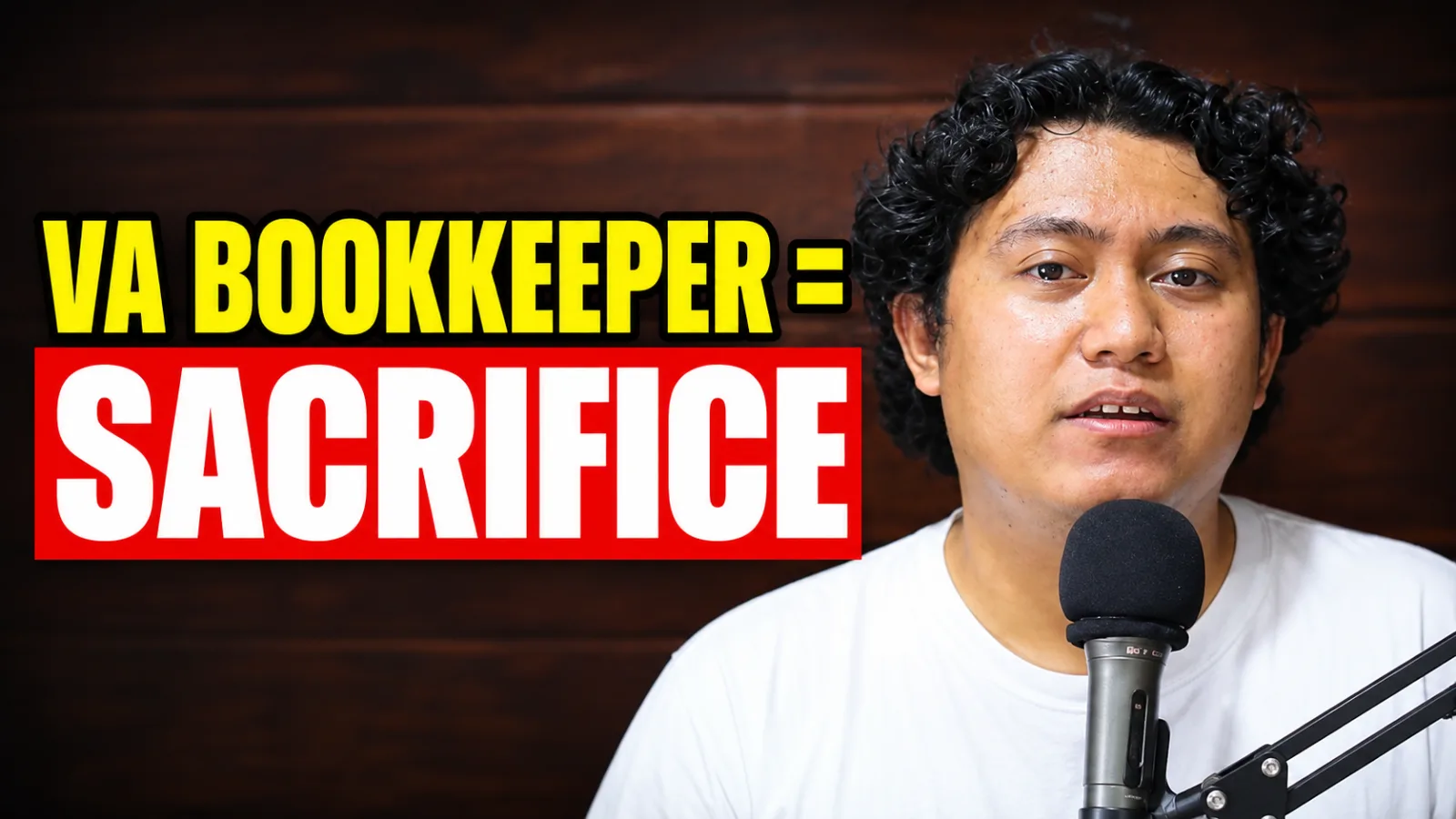
Everyone talks about the good side of becoming a VA bookkeeper. You get paid in dollars, you work from home, you get better work-life balance and a better quality of life.
All of that is true. But there is a side of this career that most beginners never hear about. These are the sacrifices that come before the stable income, before the good clients, and before the confidence.
I'm Kyle Nelson Omac. I've been a VA bookkeeper for almost five years, and I also run a business that fixes the systems and software of companies. I didn't start with a degree, experience or connections. I started as a banana chip cooker.
This post isn't meant to scare you. It's meant to prepare you. These are the hidden sacrifices I went through, and the ones you will probably face too.
Sacrifice #1: Isolation and Having No One to Ask
Before I became a VA bookkeeper, I fried banana chips for a living. I resigned because I wanted to focus fully on becoming a virtual assistant. After I resigned, it took about two months before I landed my first real client.
Here was my situation at that time. I was a senior high school graduate who had dropped out of college. I had no degree and no experience. I was around 19, not even 20 yet.
If you Google "Can I become a VA bookkeeper without a degree or experience?", the answer you'll get is yes, you don't need a degree. But my question back then was different: who has actually proven that it's possible?
During the pandemic, I posted in community after community:
"Hello po, permission to post, admin. I'm Kyle, a senior high school graduate, and I dropped out of college. Is there anyone here who didn't finish college, just a senior high graduate, who became a VA bookkeeper?"
I posted that again and again in different groups. I was desperate to reach just one person who had walked the same path as me.
Not one person replied. Nobody commented on any of those posts.
I searched YouTube, LinkedIn and every platform I could think of, and I couldn't find a single story like mine. I felt completely isolated.
Applying didn't help either. Recruiters always brought something up. If it wasn't my age, it was my degree, and if it wasn't my degree, it was my experience. For accounting jobs, those are the three factors that matter most, and I was disqualified on all three.
The people around me couldn't help either. My coworkers at the time were frying banana chips with me. If I asked one of them, "Bro, do you know how to become a VA bookkeeper?", they wouldn't know what a bookkeeper was, or even what a VA was. Five years ago, being a virtual assistant wasn't the well-known job it is today.
My parents, my sibling, my classmates and my batchmates didn't understand what I was getting into either.
This is what I believe: when you step into VA bookkeeping as an aspiring beginner, your current circle probably won't get it. Your parents, siblings and best friends may not understand, because it's a different world.
What I did about it
I stopped forcing myself to find someone exactly like me, because that person didn't seem to exist. Instead, I connected with VA bookkeepers who had already reached where I wanted to go, and I asked them for advice.
Somewhere along the way, I realized that maybe I was the prototype. Maybe I was the person who would prove it was possible.
Now when someone messages me, "Sir Kyle, I'm an ABM senior high graduate with no degree. Can I become a VA bookkeeper?", the answer is simple: I'm the proof that it's possible.
At the start, though, you'll feel like nobody understands you, and that's normal. That's why it's called a sacrifice. Accept that reality, because it only lasts at the beginning. Once you join communities, take courses and keep pursuing the path, the right people will show up. They'll help you get your first client, guide you on how to do the work and help you understand the world you're stepping into.
If you sent me back to zero today, I would make the same sacrifice again. It was worth it.
Sacrifice #2: Accepting Unstable Income at the Start
Most of us come from a 9-to-5, a corporate job, a small business or a fixed-income role. We move into VA bookkeeping because we want better income and a better life.
The hard truth is that at the start, the income is very unstable. There are ways to make it more stable over time, but at the beginning you have to accept that it won't be.
Because I had no degree and no experience, I accepted every direct client who would take me, regardless of the red flags. Low-ballers, problematic clients and suspicious clients all made the list. I took them for the experience and so I could learn what the job really was.
When you work with red-flag clients, you can't avoid things like these:
They low-ball you.
They pay late.
Sometimes they ghost you.
Your hours aren't fixed.
They make you feel uncomfortable about billing. If your invoice looks too high, they question you, so you stop billing your real hours and start adjusting them just to get paid.
Those are the sacrifices you accept as a beginner, especially if you're coming from where I came from.
I still believe that being paid low is better than not being paid at all. Working for free, giving away free samples and settling for nothing won't help you grow. You won't grow as a bookkeeper until you feel what it's like to actually get paid.
My first dollar payment
With my first client, I didn't even know how PayPal worked, and I didn't know how to bill a client.
We agreed on weekly pay. After I finished my first week, I sent my billing. He replied, "Give me your PayPal so that I can pay you." I created a PayPal account on the spot and sent him the email.
He took a while to pay, because most of my clients in my first two years were red flags. When the payment finally arrived, it was a tiny amount, and I had been stressed out just trying to collect it.
But the moment I was paid in USD for the first time, I felt so proud. I felt that my dream was getting bigger, because I had proof that a person with no degree and no experience could get paid as a VA bookkeeper.
That small amount gave me the motivation to continue. I used it to enroll in more courses and to reinvest in equipment for my work. That feeling of being paid pushed me toward who I am today.
So accept the instability at the start. You're still building the experience you need to reach the level where your VA career becomes stable.
Sacrifice #3: Rejections Before Your First Yes
Two months without a client might sound short now. But if you've ever had a fixed income, with pay on the 15th and the 30th, two months means four missed paychecks.
I was lucky that I didn't have a family of my own yet. If you do, four missed paychecks can feel like hell. You still need money for food, bills, Wi-Fi, debts and transportation.
My mom believed in me during that time, even though I had no income because every application ended in rejection. She covered the bills I couldn't pay. I'm still grateful for that.
Why I kept getting rejected
These were the classic reasons:
No degree. This was always number one.
No experience.
I was too young.
The way I spoke and presented myself. I was young and hadn't practiced. I didn't know how important it was to communicate in English, and I hadn't studied for it when I entered VA bookkeeping.
That last one turned out to be the most important factor in landing clients. It's about how you persuade the interviewer and how you present your experience, skills and ability to deliver the service you're offering. I didn't have that yet, so I was rejected everywhere.
Rejection is a filter
Someone once told me something about business that I've connected to being a VA:
"A business never really fails. It only fails when the owner chooses to let it go and close it."
The same applies to VA bookkeeping. Rejection is a filtering system. It decides whether this path is really for you.
Let's say there are 1,000 applicants.
If 500 of them can't handle rejection, they quit, and now you only have 500 competitors.
If 499 of those can only take three months of repeated rejection before they give up, they quit too.
If you're still standing in month four, you're the one left. You get the opportunities that 999 other people walked away from.
That's how I see it, but I won't pretend it was easy. For those two months, I fought self-doubt every single day. I kept thinking that maybe this wasn't for me, maybe I should look for another opportunity, and maybe it was time to change careers. It was rejection after rejection.
The small wins hiding inside rejection
I'm thankful to God for showing me that, even with all the rejections, I could find something good in the small wins.
Each time I was rejected, I had still been interviewed. I'd had a chance to speak and present myself, and that was already progress:
I was practicing how to handle my fear of facing an interviewer.
I was practicing my English.
I was learning the questions interviewers commonly ask and improving my answers.
The more I was rejected, the better I became.
Rejection isn't really a bad thing. It prepares you, and the more you expose yourself to it, the better you get. Look at experienced entrepreneurs. The ones who have faced the most rejection usually speak better, present better and understand business more deeply, because rejection shaped them.
That's why I can speak the way I do today and share as many ideas as I can. It comes from a huge number of rejections, and I still get rejected today. The difference is that I no longer see rejection as bad. It tells me either that I need to improve something or that this particular thing isn't for me.
Sacrifice #4: Handling Difficult and Unclear Clients
When I started with direct clients, I'd estimate there was an 80% chance the client would be difficult to communicate with.
Here's why. A direct client usually has you as their only employee, or maybe one operations assistant who talks to you. They hire a VA bookkeeper because they can't afford, or don't want to pay, the full cost of an on-site bookkeeper. They want it cheaper, and they still want their books in order.
They also usually expect you to already know everything.
As bookkeepers, we follow a basic rule of accounting: we don't assume unless otherwise stated. That's why we need supporting documents such as receipts, bank statements, credit card statements, spreadsheets, trackers and access to the other software they use. We also need to ask which transactions are personal and which are business, and how to categorize anything we don't recognize.
Many direct clients assume that once they've given you access to the bank, the credit card and a few spreadsheets, you'll understand everything in their QuickBooks right away. That's not how it works.
They'll often tell you something like this:
"That's why I hired you. I want you to figure it out. I want you to fix what needs fixing."
How I handled it as a beginner
I was terrified in those moments. I didn't want to annoy the client or make them angry, so I looked for ways to make communication easier while still getting accurate answers.
My first client only checked in about once a week, and there were many uncategorized income and expense transactions. From the bank memo alone, you couldn't tell where an expense came from. With the income, you couldn't tell whether the money was revenue, a loan or a personal contribution from the owner.
I was a big client-pleaser at the time, and I knew this client didn't know how to use QuickBooks. Like many direct clients, he only looked at reports. Here's what I did:
I exported the uncategorized income and expenses.
I put them in a Google Sheet.
I filtered the list and categorized everything I could on my own, so only a short list was left for him.
I added a comment column where he could type what each item was.
I used that Google Sheet link for every follow-up: "Hey, these are your pending items. I really tried my best to categorize these and figure them out, but I need your help with these."
There are many more ways to handle this today. But that was where I learned that we have to improvise. We have to handle the client's attitude and still find creative ways to get accurate data and confirmation from them, without irritating them or making things harder on their end.
They hired you to fix their problems and make their lives easier. If you make it harder for them, it's as if they're the ones working for you.
Why you shouldn't ask about everything
Here's another lesson I learned. Don't ask about everything.
If we keep asking and the client keeps answering, we become dependent on them. We stop doing deeper research, we stop trying to understand the client's business and we end up wanting to be spoon-fed.
Even when a client gives you complete access and details, there will still be items you don't know how to handle. That's your chance to find the communication style and the tools that make things easy for the client and accurate for you, all while dealing with their attitude. It's a sacrifice, and it's where I learned to innovate.
Sacrifice #5: Losing Sleep and Adjusting to Client Time Zones
This one is basic, but many people overlook it.
As a banana chip cooker, I was used to working from morning to evening, starting around 7 or 8 a.m. There was no fixed schedule. You worked until all the bananas were fried, and your pay depended on how much you produced.
When I became a VA bookkeeper, I didn't think about time zones at all. I only studied QuickBooks Online because it was popular. I didn't even know about Xero, and I didn't think about which markets used which software or which time zones I'd be working in. I only wanted to get a client.
Then I got one, a US client. That meant waking up for our meetings at their time and working whenever they were online. My clients in those first two years were hard to communicate with, so to make my workload easier, I worked during their hours. That way, whenever I had questions, they could answer right away.
I started making that sacrifice even before I had clients. YouTube tutorials back then said that if you applied on Upwork at certain hours, you had a higher chance of being noticed. I remember the times as 9 p.m., 1 a.m., 3 a.m. and 9 a.m. Philippine time, when US clients were in bed scrolling. So I trained myself to apply at those hours.
What it did to my body
To be honest, that's when I started gaining weight.
In senior high school, I was physically fit. I jogged, played basketball now and then and stayed active. After I became a VA bookkeeper, I slowly gained weight, because that's what happens when your body clock changes.
Picture the routine. You're awake from 9 or 11 p.m. until morning. You sleep during the day for maybe four hours at a time, because it's hard to sleep continuously when it's bright outside and your body isn't used to it. On Saturday and Sunday you switch back to night sleep, so the only time you get a full 8 hours is on weekends, and sometimes not even then.
When you're sleep-deprived and working nights, food tastes amazing. You're always hungry and it's hard to stop, because your brain needs fuel, and this job runs on your brain. So I kept eating, my sleep was poor, my metabolism slowed down and my calorie intake kept climbing.
Some of my batchmates who started with me were all skinny back then. After becoming VAs, they all filled out. Some of them also have kids and family responsibilities on top of the VA work, which makes it even harder.
Where I am now
Today I don't take full-time roles anymore. My schedule is flexible now. I only wake up early in the morning for a scheduled meeting or presentation. I have one US client and many local clients, so I mostly work from morning to evening and sleep 8 hours every night. For a while, I relied on melatonin just to get my body clock back on track.
If you're physically fit and don't have other big commitments, you can make it work. With discipline, you can still get 8 hours of sleep on a night shift, keep your body clock steady and eat well. But it takes effort. You have to work at it and accept it as part of the job.
At the start, you have to accept that you'll be working on your client's time zone.
Sacrifice #6: Constant Learning and Upfront Costs
This matters even more now that we're in the age of AI.
From the start, I treated being a VA bookkeeper as a personal business. I'm using my skills, time and resources to provide a service, in this case bookkeeping and accounting. Because it's a business and I'm self-employed, I have to keep innovating and adapting.
So for my first two, three and four years, and up to today, I've always had some learning or seminar related to my career that I'm attending.
At the start: QuickBooks Online for Accountants, plus a paid refresher course
Then: Coursera courses, LinkedIn Learning and various seminars
Lately: ISO auditing, business systems, business concepts and business understanding
Most recently: vibe coding and building my own apps
There's a pattern here. I didn't stop at VA bookkeeping. I've been doing it for five years, but I kept growing from bookkeeping to business systems to auditing to building my own software. Every upskill still connects back to bookkeeping.
Business systems: I study how each department in a business works.
ISO auditing: I learn how to audit processes, money, people and the work environment. That's still bookkeeping-related. You become a better auditor when you know transactions inside and out and understand the business behind them.
Building apps: I built my own website and the academy site for my programs and courses myself. Some of my clients now have their own accounting software, because the knowledge I gained as a VA bookkeeper helped me understand systems deeply enough to build one.
That's the business I run today, fixing systems and software for companies. It combines my auditing and technical skills, and you can do something similar.
This is one of the sacrifices you have to accept: keep learning and keep investing, even when it costs money upfront. That's how you build real competence as a VA bookkeeper, one who understands how your client's business actually works.
Why I'm Sharing This
I'm not sharing these sacrifices to scare you. I'm sharing them to prepare you.
Becoming a VA bookkeeper isn't spoon-feeding, and it isn't something you can simply jump into. It takes sacrifice. That's true of anything worth pursuing, not only VA work.
If VA bookkeeping is one of your options, at least you now know what's coming. Feeling isolated, unstable income, rejection, difficult clients, lost sleep and constant learning won't catch you off guard. You'll recognize them and know what to do.
Your Assignment
Now that you know the sacrifices, here's your assignment.
Apply, and aim to get interviewed five times, even if all five end in rejection.
You don't know which one will become your first client. It might be the fourth, the fifth or the very first. The goal is to experience the process.
Your current resume is good enough to start with.
Your current skill level is good enough to start with.
Find five job openings.
Prepare well and do your best in each application and interview.
Accept the rejection if it comes.
Bonus assignment: each time you're rejected, ask what you can improve, whether it's your resume or the way you speak. That feedback will stay with you for the rest of your career, and it becomes the tool that makes your sixth interview better than your fifth.
Ready to Start Your VA Bookkeeping Journey?
If you want to understand your clients' businesses and become a VA bookkeeper they can't replace, I have a free program for you. Context for VA Bookkeepers explains how to understand the industries your clients work in, such as real estate, logistics and transportation. These are industries I've worked in myself.
👉 Join the free and paid programs here: https://programs.kylenelsonomac.com
To know more about my services and writings, connect with me here. Here's my website: https://www.kylenelsonomac.com/
Don't forget to subscribe to my YouTube channel, listen on Spotify and join our community.
God loves you, and I'll see you in the next one.
Faith without action is Fiction.