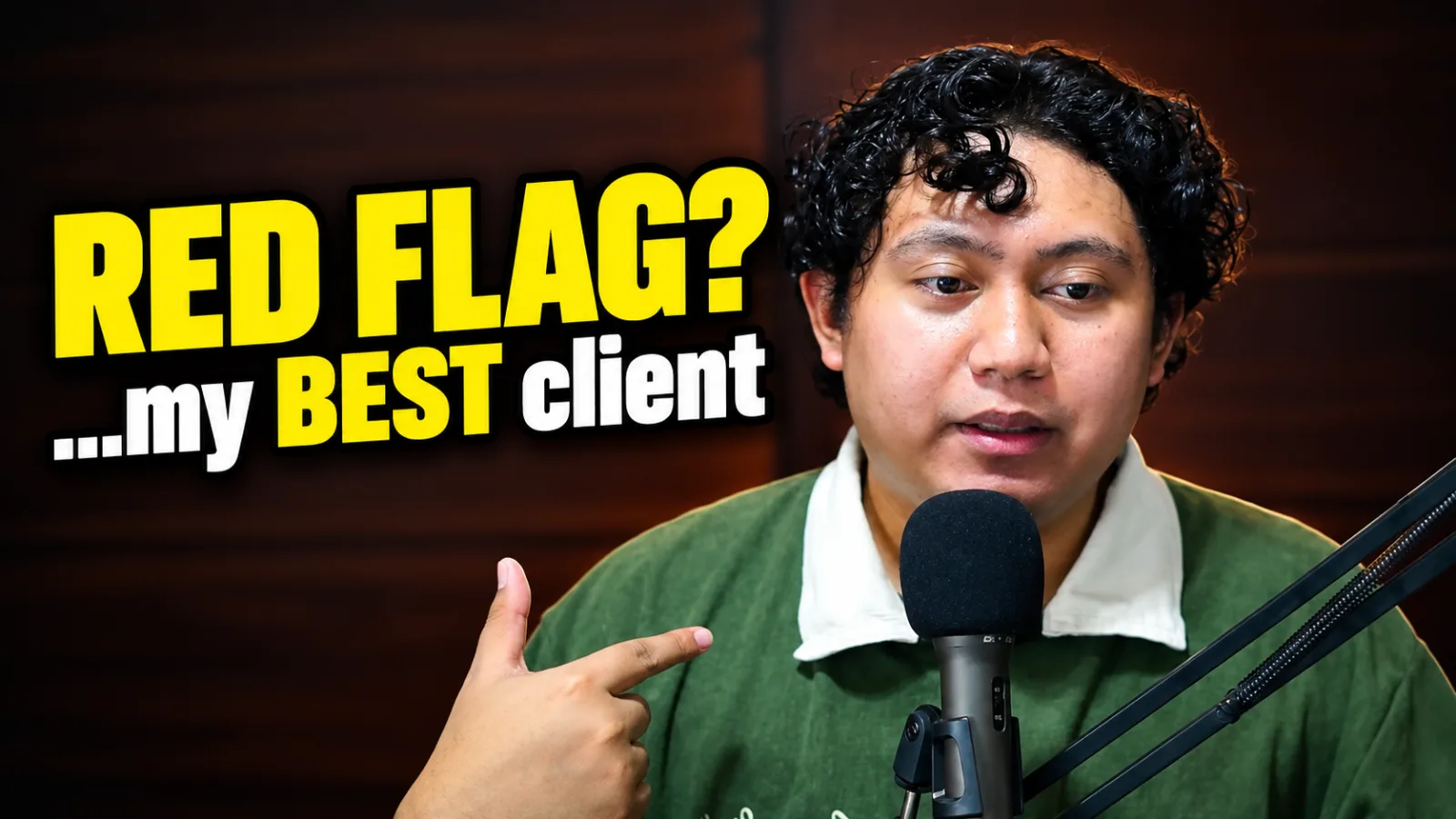
Let me ask you something before I start.
What does your ideal client look like?
Not the vague answer. The real one. Do they pay on time? How much do they pay? How kind are they, exactly? How do they treat you when you make a mistake? How do they talk to you on a Monday morning?
If you can't answer that clearly, don't worry. I couldn't either. And for almost four years of my career as a VA bookkeeper, that blurry picture cost me a lot.
This is the story of how I finally found my best and ideal clients: one foreign, one local. It's a story about rejection, red flags that turned out to be wrong, a final interview that felt like talking to my mom, and a lesson about leaving well that I'll carry for the rest of my career.
When You Have No Degree and No Experience, Everyone Looks Like an Ideal Client
When I started out as a VA bookkeeper, I was a kid. I had no college degree and no work experience. What I did have was a senior high school background in ABM (Accountancy, Business and Management). And since my batch graduated online during the pandemic, I never even got to take the TESDA certification my strand normally takes before graduation.
So I had no clear picture of an ideal client. I couldn't set a goal because I didn't know what I was aiming for.
My coping mechanism was simple: I accepted everyone.
Unfamiliar industry? I'll take it. Lowball rate? I'll take it. Toxic client? I'll take it. I genuinely believed I had no right to choose my clients. If someone was willing to hire me, that was enough. Opportunities came so rarely that I grabbed every single one.
My only filter for whether a client was "for me" was this: Will they accept me?
That's it. Shallow, right?
But you have to understand where I was coming from. My first two years as a VA were almost nothing but rejection. Internships, free service offers, lowball clients, agencies. I reached out to all of them. Almost all of them said no.
So I prayed a very honest prayer:
"Lord, I know I'm not really qualified. I don't have the qualifications to be a VA bookkeeper. But I'll take any client. If a client is meant for me, just let them accept me."
And whatever opportunity came in, I accepted right away.
Years passed. Most of the clients I worked with were lowball. If a client was kind, the engagement was short-term. If the pay was decent, I didn't last long. I'll be honest with you: it took me three to four years before I experienced what an ideal client actually looks like.
That's a long time to work with no identity and no standards. A long time without direction.
A Backwards Career Timeline
My path as a VA was a bit upside down.
I started working from home. Then I went on-site and got corporate experience in Davao City. Then I joined a VA agency, working from home again. And now I'm back in school, studying in Laguna, after dropping out years ago.
That corporate stint mattered. During my first two years, VA agencies wouldn't touch me. Their standards were high: be a graduate, have relevant experience, and on top of that, be a confident speaker. Interviews are all about how you present yourself, and I failed them. No degree, no experience, and I was bad at interviews.
But after a little over a year of corporate experience, the agencies started calling back.
How I Found the Job That Felt Like It Was Written for Me
Here's my very unglamorous job-hunting method.
I searched Facebook for terms like "work from home bookkeeper" or "bookkeeping hiring." Tip: join as many accounting groups as you can. That's where hiring managers post, and those posts show up in your search results.
I preferred listings that just asked you to send an email. Application forms aren't my strength because I can't build rapport through a form. With an email, I can.
One day, I found a post from an agency hiring a real estate bookkeeper: at least 3+ years of experience, knowledgeable in QuickBooks Online, and able to work US Central Daylight Time (CDT).
Have you ever read a job description and felt like it was talking directly to you? That's exactly what I felt. This one's mine. I fit every qualification, and it didn't ask for a college degree. Just experience.
So I applied. I updated my resume, polished my email draft, hit send, and then forgot about it.
That's how I apply, guys. I send lots of applications, each one customized, with a good cover letter and an updated resume, and then I let them go. I only start thinking about an application again when a recruiter replies.
But once a recruiter tells me I'm shortlisted or invited to an initial interview? That's when I get persistent. I follow up. What's the status of my application? How did the interview go? Is there any feedback?
Because following up is one of the clearest ways to show a recruiter you really want the job.
Inside the Agency Interview Process
The agency messaged me. They were impressed with my qualifications and wanted to interview me.
If you've never gone through a VA agency's hiring process, here's roughly how it works:
Initial interview. A quick fact-check of your resume. Whatever you say has to line up with what you wrote. You'll also do a speed test, a personality test, and submit details like your computer specs, internet specs, and laptop brand. I had all of that ready.
Follow-up interview (sometimes skipped).
Managerial or operations manager interview.
Final interview with the client.
In my case, it went from the initial interview straight to the managerial one. First I talked with a Filipino staff member, then with the agency boss.
During that interview, I mentioned that I create content and that I'm on YouTube.
"Oh, you do YouTube?" the manager asked. "How many subscribers do you have right now?"
At that time, I had about 200 subscribers. I told him honestly: "I'm only starting out, and I only have 200 subscribers."
His reply surprised me.
"Oh, you should be proud of yourself. And I think the client will like you, because she does content as well. I think you're on the same frequency."
He gave me the name of the company so I could research it, in case I made it to the final round. As far as I know, three of us were shortlisted for the final interview with the client.
Two or three days later, I sent a gentle follow-up. "I hope this email finds you well. I would like to follow up on my application." Nothing fancy. Just enough to show I was serious.
I'll say it again because it matters: following up really matters. It shows that you're dedicated and that you genuinely want the job.
About a week later, the agency told me I'd been chosen for the final interview.
The Final Interview: "This Client Is a Red Flag"
The agency briefed me on what the client might ask, and I prepared like crazy. Resume on screen. Role-playing in my head. Practicing in front of the mirror. I even wore my sharpest polo.
Then came the waiting room.
If you've ever sat in a Zoom waiting room before a final interview, you know that feeling. Just staring at the screen, waiting to be admitted. My heart was pounding.
When she finally let me in and turned her camera on, my first thought was: she looks like she's my mom's age. Somehow that put me a little more at ease.
Then I noticed her desk. And the room behind her. It was a mess.
Her first words: "Hey Kyle, I'm really sorry I'm late admitting you." She'd kept me waiting for about five minutes. She was still tidying her table, and she started telling me how much had happened that morning. She vented a little. In a final interview.
Then she explained why she was late: she'd been reading her new book, which she had just published on Amazon, and she lost track of time.
In my head, the alarm bells went off. Red flag.
I'd heard it from so many bloggers and VA creators: a client who's always late to meetings is a red flag, because it shows they don't respect a VA's time. So there I was, mentally labeling her as a red flag before the interview had even started.
The Conversation That Changed Everything
After some small talk, she said, "Okay, let's start. Can you tell me more about yourself?"
I shared my years of experience, the tools I use, where I'm strongest, and, as I always do in interviews, that I create content, blog, and teach.
I always mention it because it's true and because anyone can search my name and see it. And every time, clients light up. You can see curiosity in their eyes, a little "wow" moment. Try it yourself: teach and create content. It works.
When I mentioned it, she said, "Oh, I do content as well." She told me about her podcast and her blogs, and why she writes. Then she turned the question back to me.
"Why are you doing it?"
I answered honestly:
"I really want to help my fellow Filipinos, especially accountants and bookkeepers, get the opportunity to work from home and have better purchasing power."
I explained that many accountants in the Philippines are underpaid and stuck in toxic, unhealthy work environments. My goal is for them to experience being paid well.
She just kept nodding.
Then I added something I always say: "But honestly, I have no data on whether it has changed anyone's life. I just share, and then I forget about it. As long as I'm able to share, that's my goal."
She nodded some more and went quiet for a while.
So I broke the silence. "You said you just published a new book?"
She held it up proudly. Then she said, "Kyle, I'll send you a copy of this book. You can read it anytime." And she emailed me the soft copy right there, in the middle of the interview, before I was even hired.
I confirmed I'd received it, and then I shared that I had just published a new book too. I've published three books online, and I held up the hard copy. I told her I'd released it on my birthday, because every birthday I like to put something new into the world.
She looked at it and said, "I think we can write a book together."
She hadn't hired me yet. But I was starting to get the idea.
We had so much in common. At the end, she told me, "Kyle, I'll update you on the result. It's really nice to meet someone with this much rapport."
I thanked her for her time and for the stories she shared, and told her I really enjoyed our conversation. Then the call ended.
Two or three days passed. I followed up. And on a Saturday, the email came:
"Kyle, you are hired."
I'd had no job for months. I thanked God, and I thanked the agency for keeping me alive and giving me this opportunity. We'd start on Monday.
What an Ideal Client Actually Looks Like
On Monday, she gave me a tour. She ran a bookkeeping firm whose clients were all in real estate. She used accounting practice management software that listed all her clients and connected to QuickBooks Online. From there, you could see which tasks were still open and which transactions were still missing a class or category.
It was my first time working with a setup like that. She gave me access to QuickBooks, a company email, everything.
I caught up fast. Most of my clients over almost five years had been in real estate, so the work felt like home.
And then the meetings started. And they were... stories. Updates on her life. Updates on mine. Updates on our team. Personal things.
She knew I was studying. "Kyle, are you still in school?" she asked. I'd just gone back. She was so supportive: "Don't stress yourself too much. I know you can deliver the work. Just meet the deadlines, do what you can, and the team is here for you."
Our relationship was honestly about 70% relationship and 30% work.
Here's what made her my ideal client:
She paid on time. (The agency handled payroll, and it was never late.)
She was incredibly kind and considerate.
I never felt pressure. Even as her team grew and her client base expanded, I didn't feel the weight. I was actually happy when she got new clients.
I enjoyed the work.
For the first time in my career, I had a clear picture of what an ideal client really looks like. Not a guess. Not a wish list. A real, lived example.
But here's the other side of it: I never took advantage of her kindness. I worked well. I was competent. Whatever task she gave me, I could handle, because I'd put years into getting good at this. In a way, I was her best employee and she was my best client. It honestly felt like a mother-and-son relationship.
Why She's Still My Best Client, Even After We Parted Ways
Eventually, she went through a personal problem, and she could no longer manage things the way she used to. We separated.
So why is she still my best client?
Because we parted well.
Since she ran a real estate accounting firm, she had many clients. One of them was a client I'd been working on directly. She handed that client over to me herself. She told me:
"Kyle, I've told this client to hire you directly. I'm really sorry for what happened. We'll talk soon."
To this day, she hasn't removed my email or my access. I don't know why. Maybe she has plans for the future.
Now, here's something I want every VA to hear.
I never poached her clients. It would have been easy. I had direct contact with all of them. But I would never do that. That's not who I am. Stealing a client from the person who gave you a chance is a low move, and I refuse to be that kind of person.
She gave that client to me willingly. About three days after the turnover, the client reached out to me. And today, that's my client. And guess what? They're also a best and ideal client. Kind, easy to work with, and our meetings are mostly just friendly conversations.
When You Get Good Enough, the Work Becomes Relational
There will come a point in your VA career when you're so good and so competent, and you've improved your skills consistently, that you stop talking only about work.
The meetings, the metrics, and the KPIs never disappear. But when you consistently meet them, the relationship takes over.
"Oh, it was your kid's birthday? How did it go?" "It was my birthday last week too!"
It becomes that simple. That human.
I invest heavily in relationships. I'm willing to spend time, to sit with you, to get to know you, professionally and personally. Because that's where trust is built between people. Being a real person with real people.
That's the story of my ideal US client. I'm so blessed by it.
But don't miss this part: it took me more than four years to experience an ideal client. Most of the years before that were a storm. Glory to God that I got to experience it at all, even without a degree and without experience.
I'm not financially rich or "successful" yet. But I can honestly say my work is blessed. And I'm confident I won't run out of work, because I'm competent, and because there are many people willing to help me, since we've built real relationships.
My Best and Ideal Local Client
Do you think being a VA bookkeeper only works with US, EU, or other foreign clients?
No.
I have a local client too, and here's that story.
You might notice I talk a bit like a businessman. That's because, even though I'm still in my early twenties, most of my friends outside school are entrepreneurs in their 30s, 40s, 60s, even 70s. Some are millionaires, some aren't. I'm the youngest in the group, and they treat me like family.
Being around them, I absorb their problems. I've also been blogging and making content. On my YouTube channel, I have a business terms playlist that breaks down the basics: quotations, estimates, invoicing, job orders, operations, departments, accounting, HR, and more. My entrepreneur friends watch it.
So when the topic turns to systems, accounting, or software, they come to me, the youngest one at the table, for advice. Because entrepreneurs don't care about your age. They care whether you can solve their problem.
This client has been with me for about two to three years now. He's also a friend.
I'm originally from Mindanao, from the Davao region. When I resigned from my corporate job in Davao City, this entrepreneur friend from Cavite told me: "Come straight to Cavite and fix my system."
So I did. I resigned and went directly to Cavite. That's how I ended up in Luzon, and now I'm in Laguna.
His problem was painfully common. We used to hang out on Zoom calls, and he'd always vent:
"Every time I ask my employees for receivables, I just get irritated because they can't give it to me. Something so simple. Total sales for the month, they can't give it. Inventory, they can't give it. Payables, they can't give it."
They had Excel files, but nothing was properly checked or consistent. So as the owner, he couldn't see the numbers of his own business.
I told him, "That's a basic problem. Let's set up QuickBooks Online and it's solved."
So I went to Cavite, installed QuickBooks Online, did a quick transition, and suddenly the numbers were visible. We fixed the business processes too. He became one of my very first local QuickBooks Online clients.
And this year, we went one step further: we moved from QuickBooks Online to our own accounting software, which I built.
From VA Bookkeeper to Building Accounting Software
That's why I say I build systems and software for companies. Today, I create my own software, built to be secure, backed up, and aligned with BIR and ISO standards. It isn't certified, but it follows those standards.
Someone asked during the live: "Are you IT?"
No, I'm not. I learned about systems because I've been a bookkeeper for almost five years. When you've been a bookkeeper that long, you get very comfortable with accounting software. You understand the chart of accounts, how journal entries work, and how the system moves underneath.
I only learned QuickBooks Online at first. But I've since onboarded clients on Wave, Zoho, and NetSuite, and when I went corporate and used a different cloud-based system, I caught up quickly. Why? Because as a VA bookkeeper, if you're willing to learn, you come to understand how the system works. And once you understand the system, building software becomes much easier, especially now that AI exists.
But even with AI, I build to standards. One of the first questions in auditing (I've done internal audit work and I'm studying it now) is this:
If the AI disappears, can you still maintain and update the software?
My answer is yes, because I still follow standard programming practices:
The code lives in a proper IDE, uses Git, and is stored locally on my laptop.
Backups are kept in multiple places, on Google Drive and locally.
The application database has its own backup database.
Hosting can be moved to another provider anytime if it goes down.
Privacy and security are covered in the website policy.
ISO has standards for quality management, environment, social responsibility, security, networking, and software. I follow them even without certification, because following the standards keeps the software safe.
One of my goals is to become an ISO Certified Auditor, and to earn my degree around 2028 or 2029. I share that because I want you to know it's never too late to start.
What Being a VA Bookkeeper Has Given Me
Being a VA bookkeeper has brought so much into my life, and it has changed it.
Without a degree and without experience, it let me:
Experience work-from-home jobs
Get hired by corporations and agencies with high standards
Fund my own education, both academic and professional
Connect with amazing people in entrepreneurship and business
Contribute to our country by helping others and paying my taxes
I won't give up on the Philippines.
Quick Answers From the Live Q&A
What does a VA bookkeeper do day-to-day? It depends on the industry, but the standard daily work is recording income and expenses, categorizing transactions from the bank feed in your accounting software, and reconciling your books against the bank account.
Australian or US clients? It depends on your goal. If you want a day shift, go for Australian clients. If night shift is fine and you want better currency conversion, US clients are a good option.
Xero or QuickBooks: which is easier? In almost five years, I've worked with NetSuite, Wave, Zoho, QuickBooks Desktop, and more, but never Xero, since I haven't had an Australian client. So I can't compare them fairly. QuickBooks is what I've used for the past four years.
Should I get TESDA-certified before taking Xero or QuickBooks courses? Not necessarily, but it helps. The mistake is jumping straight into QuickBooks and then going back to TESDA and accounting basics afterward. Learn the fundamentals first.
I already have accounts payable and receivable experience, but not with Xero or QuickBooks. Is that okay? That's fine. The important thing is that you have experience. Honestly, you're lucky. When I started, I had no experience and no degree. Most clients, if not all, prefer experienced bookkeepers.
Any tips for a fresh BSA graduate with no experience? I don't believe anyone has zero experience. Maybe you just haven't seen how your experience relates to the job description yet.
Any job-hunting tips? If you already have accounting experience, apply to agencies right away. Join lots of accounting groups on Facebook, search "work from home bookkeeper hiring," and keep applying. And please, fix your resume and your public profile. One of the most common reasons people don't get hired is that they're too lazy to polish their resume. Recruiters will search your name online, so make sure what they find works for you.
Final Thoughts: Define Your Ideal Client Before You Need One
If I could go back and tell my younger self one thing, it would be this:
Get a clear picture of your ideal client. Write it down. How they pay, how they communicate, how they treat people, what industry they're in. Without that picture, you'll accept everyone, and you can lose years without direction like I did.
And when you finally find a great client:
Don't judge too quickly. My "red flag" turned out to be the best client I've ever had.
Never take kindness for granted. Match it with competence.
Invest in the relationship. Trust is built between people, not between invoices.
Leave well. How you part ways can open the door to your next ideal client.
Never poach. Integrity is a long-term asset.
If you want to go deeper than this story, which is only the tip of the iceberg, I teach the context behind VA bookkeeping in my programs: how the accounting department and its sub-departments work, the job roles in each industry like real estate and manufacturing, and why accounts receivable, accounts payable, and property management work the way they do. There's a free program and a paid one, and the free one is already packed.
👉 Join my programs here: https://programs.kylenelsonomac.com
To know more about my services and writings, connect with me here. Here's my website: https://www.kylenelsonomac.com/
You can also find me on YouTube, TikTok, and Spotify. Search Kyle Nelson Omac.
God loves you, and I'm cheering for you.
Faith without action is Fiction.