For years, I told myself I was good at almost everything in business. Systems, software, workflows, understanding how a business model actually works — all of that came easily to me. Accounting and operations? Second nature.
But there was one thing I was convinced I was terrible at: selling.
I believed that if my freelance bookkeeping business wasn't growing the way I wanted, it was because I couldn't sell well enough. If only I could close more clients, talk more convincingly, market myself better — that's where the fix had to be.
Then one ordinary night out completely changed how I saw the problem.
An Unplanned Night That Led to a Realization
I'm currently based in Laguna, where I'm also a second-year college student. Early into the semester, a few classmates invited me to a local fiesta happening in town — there was a concert lined up, with a couple of local acts opening before the main performer everyone was waiting for. I'm not really into concerts or big crowds, but I said yes anyway, mostly because I wanted the chance to explore the area since I hadn't had much time to do that yet.
Before the event, our small group stopped to eat and kill time. That's where I first really talked to one particular classmate — someone noticeably older than the rest of our block, already in his 30s, with years of real work experience behind him. Up to that point we'd only exchanged small talk. But once the music started and everyone else drifted toward the crowd to dance and enjoy the show, the two of us ended up standing off to the side instead, talking about life. It turned into a surprisingly long, honest conversation — the kind where you realize you and someone else are on a similar wavelength, even with an age gap between you.
That conversation didn't fully resolve that night. It picked back up almost a week later, on an ordinary Thursday after our morning class.
Lomi, a Question, and a Pause
I was groggy that morning — the kind of sleepiness that only hits during a 9-to-12 class, never at night. Right as class was dismissed and everyone perked up to head out, this same classmate — I'll call him Brad, since that's what I called him that day — caught up to me and said we should grab lomi for lunch. I agreed, hopped on his motorcycle for the short two-minute ride, and we got to the lomihan.
He ordered two servings of jumbo overload lomi — enough food for four people, honestly — and casually paid for both without making it a big deal. While we waited for our order to cook, he asked me directly: "You're a bookkeeper, right?" He'd seen my content on Facebook, where we were already connected, and had reacted to a few of my videos before.
I told him yes — I do bookkeeping, and I'm also a VA. That's my actual work, and it's also what I create content about. Then he shared a bit about himself: he does massage services, bakes and sells cakes on the side, and is constantly taking NC2 and NC3 certification exams because he genuinely enjoys upskilling. Then he brought up something I'd mentioned once in our classroom — that I'd tried several entrepreneurial ventures in the past, and every single one had folded. None of them survived.
He asked me plainly: why do you think those businesses failed? Why didn't you push through and keep them going?
It wasn't the first time someone had asked me that. So I gave him the answer I usually give. I told him systems are easy for me. Software is easy. Training people, delegating tasks, understanding the full accounting picture of a business — all basic to me. My real problem, I said, was that I never caught up on the sales side, which is arguably the most important part of keeping any business's cash flow alive. "I'm weak at selling, Brad," I told him. "Pair me with someone who actually knows how to sell, and I'm confident our business would take off — because everything else, I already know."
He looked confused. He pushed back immediately: "But you're weak at selling? You talk in front of the classroom, you present, you vlog. You clearly have the nerve to speak and to sell." And honestly, in that moment, it hit me too — I do talk freely on camera, I do pitch ideas, I don't struggle to hold a conversation with strangers. So why did I keep telling myself I was bad at selling and marketing?
The Moment It Clicked — Over a Spoonful of Lomi
I sat with that question while we waited for our food. I told him his point was actually making me think. Then the lomi arrived — an enormous bowl, exactly as jumbo as advertised. While I prepared my bowl — onions, chili oil, a bit of calamansi — the question was still sitting in my head, unresolved.
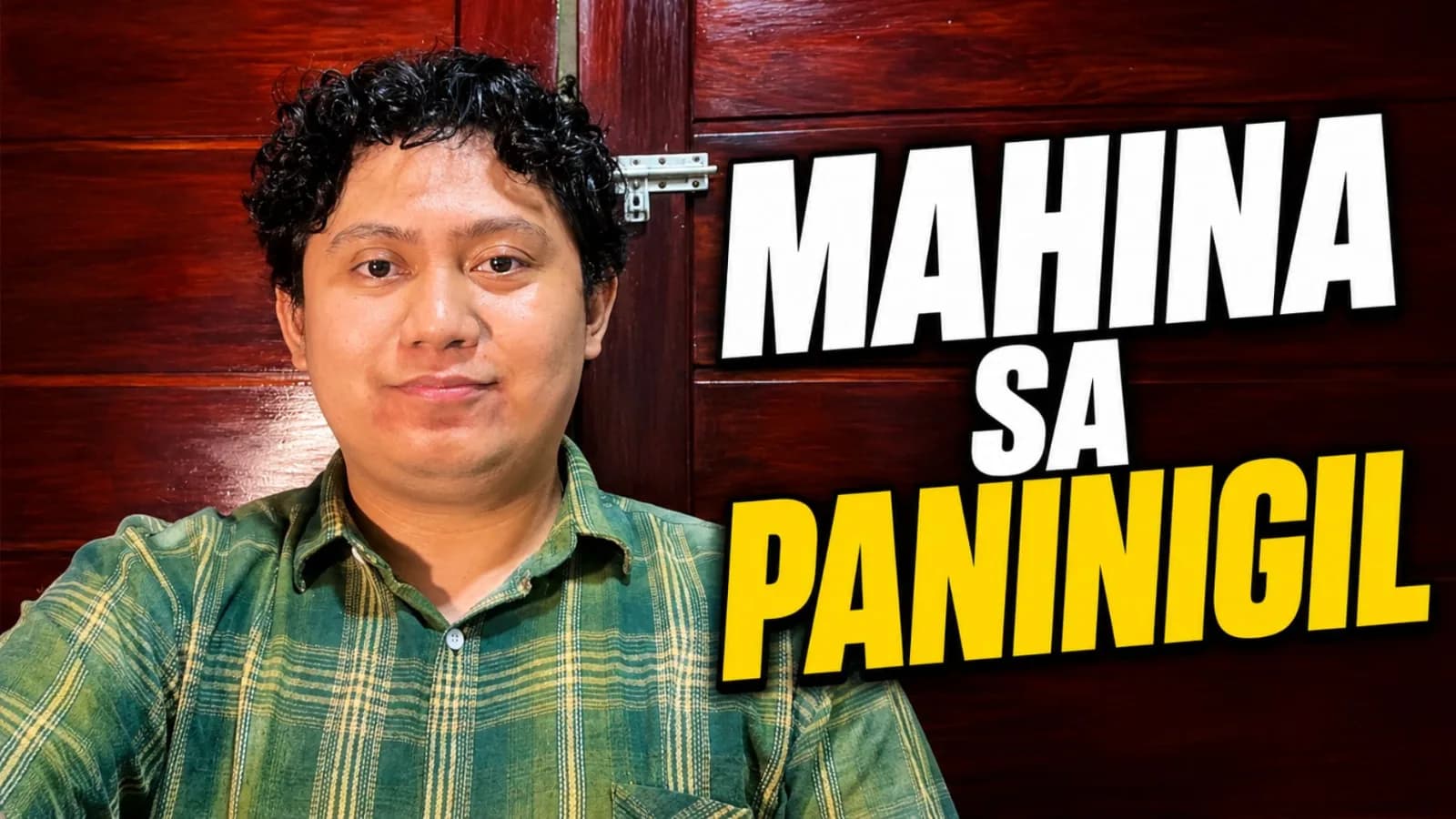
Right as I was about to take my first spoonful, it hit me: it was never about selling or marketing. I was weak at charging — at paniningil.
The realization landed so suddenly that I said it out loud between bites, still half-laughing at myself: "Hindi pala ko sa pagbebenta, hindi pala ko sa marketing mahina — mahina pala ako sa paniningil." I even admitted to him, a little sheepishly, that the real reason I hesitated to charge properly was that I didn't want to come across as arrogant or full of myself. In my head, if something felt too easy for me to do, it somehow felt like it didn't deserve a real price tag — like I hadn't "earned" the right to charge for it.
Brad, still eating, offered his own perspective. He told me about something his boss in the massage business once told him: never be shy about charging what you're worth, never be shy about pricing high. He used the word "gahaman" — greedy — and honestly, that specific word didn't sit right with me. It felt like it carried the wrong connotation, like charging fairly was somehow predatory. But even without accepting that exact framing, the underlying point still made sense to me.
Why This Distinction Matters
Sitting with it more, I realized the issue wasn't only about cost of goods, or how much time a task takes, or even how much value it delivers to the client — though all of those matter. There's something deeper underneath pricing that I still couldn't fully name. But at least I now knew where the actual gap was: not in my ability to sell, but in my willingness — or lack of it — to ask to be paid what the work was worth.
That afternoon, after class ended, I went straight back to my room and actually opened a calculator. Nothing dramatic happened from it yet — I'm not at the point where the pressure of time and money has forced my hand. I don't have dependents. I'm not the breadwinner in my family; my mom and sibling are resourceful enough to manage on their own, and I mostly just worry about their expenses from a distance. I live alone here, covering all my own costs, though I'm still supported emotionally by a tight circle of entrepreneur friends I regularly connect with — some of them through a Discord community that has been a huge blessing in my life.
Because I haven't yet felt that real financial pressure, I also haven't felt the urgency to charge more. Some of my friends have pointed this out before, half-joking, half-serious — telling me I'd understand it better once I had a spouse or kids depending on me. I don't reject the logic behind that. But it's also not advice I plan to follow just for the sake of feeling urgency. Marriage and having children aren't things you rush into just to manufacture pressure on yourself — those are decisions that deserve real intention, not a shortcut to learning a business lesson.
The Advice I Won't Forget
Later, Brad shared one more piece of advice — the one that actually stuck with me the most, the one I keep coming back to even now:
Charge low, intentionally, for your first five clients. Let them consume your time fully. Pay close attention to how much of your energy, attention, and hours they take up — and notice if that cost never quite gets reflected in what you're charging. If you feel that mismatch, that gap between what you gave and what you were paid, that's exactly the signal you need. It means you're ready to charge more for the next client who comes after them.
You come to understand your own value once you feel your time is actually running out — once giving your hours to an underpaying client clearly means taking those same hours away from your family, your own growth, or your own life. That felt-cost is what eventually makes you comfortable asking to be paid properly, without guilt and without over-explaining yourself.
Where I Am Now
I'll be honest — I don't have this fully figured out yet. I'm still a student of pricing, still learning how to price my own services correctly. But this conversation was significant enough that I didn't want to forget it, which is exactly why I'm sharing it here.
If you're a freelance bookkeeper or VA who feels stuck — like your business isn't growing no matter how much effort you put into selling — it might be worth asking yourself a different question: is this really a sales problem, or is it a pricing problem?
Sometimes the block isn't in how well you can pitch. It's in whether you actually believe your time deserves to be paid for.
To know more about my services, writings -- connect with me here --- here's my website: https://www.kylenelsonomac.com/