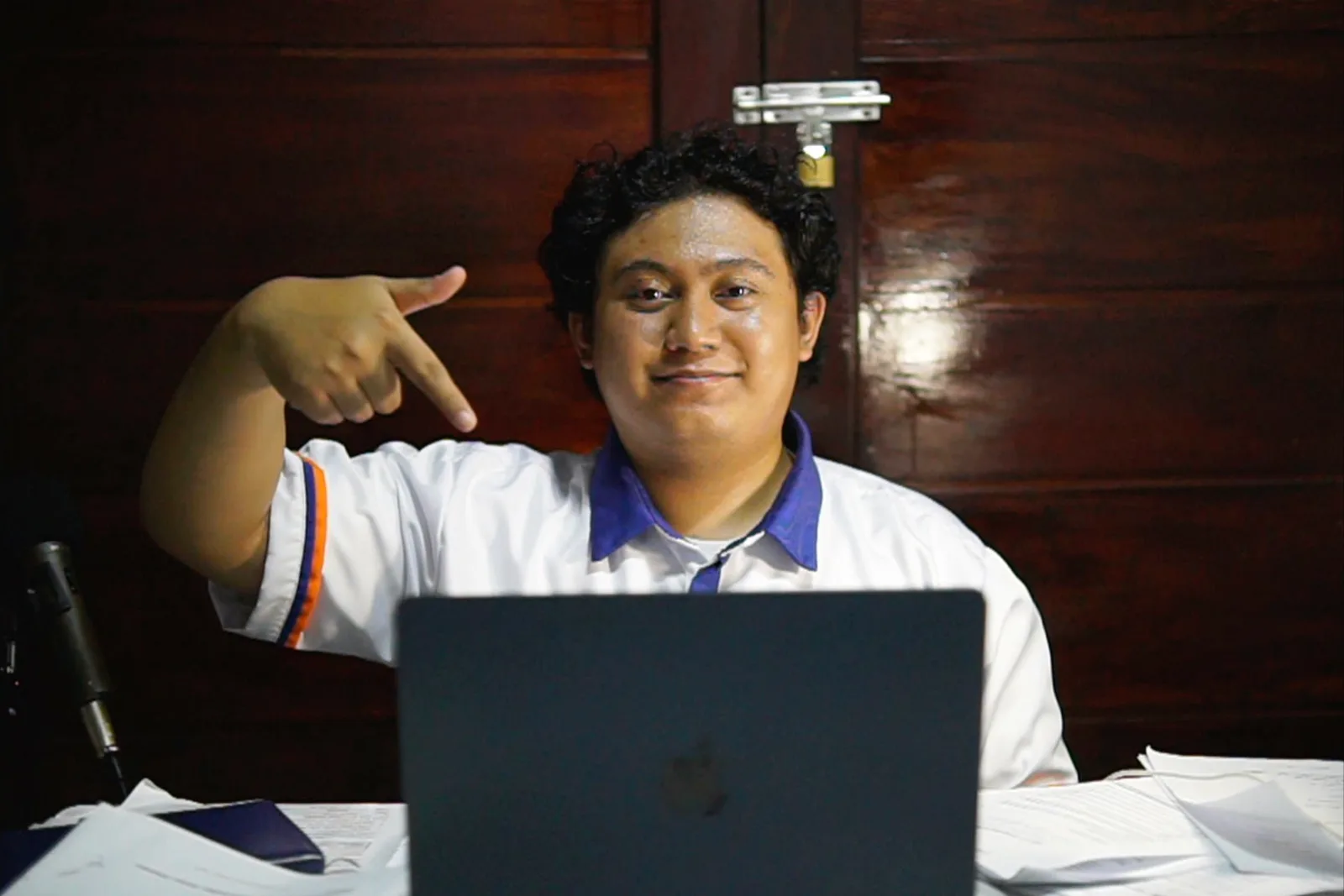
As I write this, picture me in my school uniform.
I recorded the video this post is based on in between my midterm exams. I had just finished one paper, I was waiting for the next subject, and I still had to go back to campus in a few minutes. And in that small window of time, one thought kept bugging me: students need to hear this.
Young people need to know that you can earn while you're still studying. You can teach yourself a skill. And yes, you can become a virtual assistant (VA) bookkeeper even while you're still a student.
I'm Kyle Nelson Omac. I've been a VA bookkeeper for almost five years now, and my focus is on systems and software. If you're a student who's curious about virtual bookkeeping, this one is for you.
Where It All Started: Senior High School ABM
Before I ever became a VA bookkeeper, I was a Senior High School graduate of ABM, Accountancy, Business and Management.
That's where my interest in accounting was born. ABM taught me the fundamentals of accounting, and it was there that I first heard about the CPA, the Certified Public Accountant. Honestly, before senior high, I didn't even know that job existed. But the more I learned, the more I realized how crucial accounting is, and how in-demand it is for every single business.
So from senior high school onward, I made a decision: whatever job I take, my career has to move toward accounting.
Dropping Out During the Pandemic
When I reached college, of course I took up a Bachelor of Science in Accountancy.
I didn't even finish the first semester. I dropped out.
It was the pandemic. I wasn't learning much, and I had to make a hard choice: keep studying, or start my employment journey. I chose work.
My first job wasn't anywhere near an accounting office. I was a banana chip cooker in a banana chip factory.
But here's what that job gave me: the means to save money for training in US bookkeeping courses.
The Phrase That Gave Me Hope: "Work From Home"
During the pandemic, one term was everywhere: work from home.
That phrase lit something in me. It gave me hope that I could still get back to the accounting industry I had dreamed about since senior high school.
So I went straight to Google and searched: Can you become a VA bookkeeper without a degree?
The answer never changed, no matter how many times I searched. You don't need a degree to be a VA bookkeeper. What you need is:
Accounting basics, and
Knowledge of the software, so you can connect your accounting knowledge to the tools clients actually use.
Both matter. If you jump into the software without understanding accounting, you'll only mess up your client's business. And if either one is missing, finding clients becomes really hard.
Resigning With Zero Clients
While cooking banana chips, I saved up and finally bought a bookkeeping course. And once I had it, I wanted to take being a VA seriously. So I did something a lot of people would call reckless.
I resigned from my job without a single client. No guarantee that I'd ever get one.
What followed were the hardest two months of that season.
Two months of self-doubt. Two months of training and more training. Two months of connecting here and connecting there. Two months of applying consistently. Two months of interviews that ended mostly in rejection.
Looking back now, two months sounds short. I almost laugh at it, because those two months are the reason I'm still a VA today. But while I was inside those two months, the struggle was heavy. The self-doubt was heavy. More than once, I almost gave up on the decision I made when I resigned.
But by the grace of God, who kept giving me hope over and over, I finally landed my very first client.
My First Clients and the Mistake I Made
I'll admit something here. In my early days, I was the kind of person who was weak at charging and weak at asking for anything.
Whatever the client gave me, I accepted. Whatever job they handed me, I took, regardless of whether it matched the job description. I saw everything as "experience." My mindset back then was: I don't even have a degree. Who am I to demand anything?
For my first two years as a VA bookkeeper, even while I was already creating content and sharing what I knew, the work still wasn't sustainable. I wasn't rich. I wasn't even comfortable. I earned just enough to live. But I learned a lot, way more than what I was being paid for, because my workload never matched my rate.
What kept me going? The thought that at least I was building my résumé. At least I was building credibility as a VA bookkeeper in this industry, even without a degree.
The Turning Point: A Corporate Job in Davao City
During those first two years, my income was inconsistent. Cash flow came in, then didn't.
But because of all those experiences, something flipped my life around. I got hired as an Accounts Payable staff for a US company with an office in Davao City.
They didn't hire me because I had a degree. I didn't have one. They hired me because I was qualified through the experience I had piled up as a VA. I was one of the youngest people there, around 19 or 20 at the time.
That was my first accounting-related corporate job. And it changed everything.
Before that, VA agencies kept rejecting me. No degree, not much experience, inconsistent track record. I applied to well-known agencies and didn't get in anywhere.
After the corporate experience? I started reaching final interviews. Client matching. I even had accounts set up with agencies, just waiting for a client to be assigned, and the only reason I didn't push through was because they were full-time roles.
From there, my credibility in the virtual bookkeeping space kept getting deeper. So did my expertise and my competence. And that's when being a VA truly started paying off.
Going Back to School While Working as a VA
When I finally felt real cash flow coming into my personal finances, I decided it was time to study again.
That decision shaped the kind of work I accepted. I chose clients and roles that weren't fixed or full-time. Yes, that meant earning less than a full-time setup would pay. But I chose freedom, because I wanted to finish my degree.
I went back to school last year, in 2025, while continuing to work as a VA. And that's when it hit me: it really is possible to be a VA while you're a student.
Sure, I already had experience before I enrolled. But that doesn't change the fact that I am a student and a VA at the same time.
That realization is what pushed me to start uploading videos about being a VA bookkeeper. I went live, ran webinars, and taught. That whole playlist was born from one vision: it's possible to be a VA even while you're studying.
I tested it on myself. I looked back at my story and thought: I made it without a degree. How much more now that I'm actively working toward one?
If I Were Starting Today as a Student: 3 Tips
If I were starting from zero right now, as a first-year or second-year college student, or even still in senior high, and I wanted to become a VA bookkeeper, here's what I'd do.
1. Take ABM and Your Accounting Subjects Seriously
If you're in Accountancy, Business and Management, take it seriously. To be honest, I still review the book I used in senior high school from time to time. It's that relevant, whether you're going into accountancy, business management, or VA bookkeeping.
Senior high is where you learn the fundamentals of accounting. And for a VA bookkeeper, what matters most is that accounting becomes part of you. It's in your head, in your blood, in the way you see the world.
You should be able to look at a business transaction and immediately know how to analyze it and how to record it.
It should be that automatic. Picture yourself at a restaurant, paying cash at the counter. A part of your brain should already be thinking: From the business's point of view, cash increased, and so did sales.
When accounting is that natural to you, you've got the fundamentals down. That's what matters.
2. Pick a Schedule and a Time Zone That Won't Clash With School
This is where most students struggle. How do you keep studying while working as a VA? Your schedules collide. Or you're just too drained to work for someone else after a full day of classes.
Here's my suggestion: choose a work setup and a learning path that fit around your school schedule.
If you have evening classes, don't sign up for bookkeeping courses that also run at night. Take the morning ones.
Now let's talk about time zones:
Night classes (say, 5 PM to 9 PM)? Aim for work from 11 PM onward. That's a natural fit for US bookkeeping, which is usually night shift for us in the Philippines. The software you'll likely use is QuickBooks.
Afternoon classes? Work from early dawn to morning. That's where Australian clients fit in, and the software you'll likely use is Xero.
Once you choose a time zone, commit to it until your fourth year, until you graduate.
Then protect that time. Use those specific hours for studying, mastering the software, connecting with people, and growing yourself as a VA bookkeeper. Eventually, those same hours become your working hours.
Being a VA doesn't automatically come with a fixed schedule. You decide when you'll learn it, and you decide when you're available to work.
3. Don't Rush to Earn Big. Aim to Last.
This is the one I want you to remember most.
I realized that I lasted as a VA bookkeeper not because the dollars were huge. I'm not "successful" in the flashy sense. I'm not financially free yet. But my personal needs are sustained, I'm living, and I'm able to study properly. Right now, I chose freedom.
I used being a VA as a tool, a vehicle that keeps my life moving forward without money being a constant problem. And at the same time, it fuels my long-term dreams.
That's the mindset I want for you if you're still a student. Don't pursue getting rich right away.
Pursue the ability to keep doing the things you love and the things you need to do, without constantly worrying about money, because you already know how to earn it. Don't rush to grow your income fast, because right now you have other commitments that need your time and energy.
Your goal is to sustain yourself until you graduate.
And once you do graduate? You'll have more time. You'll already have experience from working while studying. Finding bigger clients won't be as hard, because by then you're credible, and you've stayed in the industry long enough to prove it.
Quick Recap
Master the fundamentals of accounting. Take ABM and your accounting subjects seriously.
Fix your schedule. Choose a client type and time zone that won't clash with school, and learn the matching software: QuickBooks for US clients, Xero for Australian clients.
Don't rush. Your goal is to sustain yourself until graduation, not to get rich overnight.
Why I'm Sharing This
I want students to see that we have a lot of options to earn money today. You can start a small business. You can have a side hustle. And don't forget, you can also become a VA, which is one of the most convenient paths for students right now. All you need is Wi-Fi, a stable internet connection, and tools like a laptop to operate as a virtual assistant bookkeeper.
Here's what I believe is our real enemy: we limit ourselves because of the things we can't yet see.
So many of us wait until we graduate before trying to earn, because we've been told that no one will pay us well without a degree. That's the wrong principle. It's possible, and there are many ways to make it happen.
It's not easy. But believe me, it's going to be worth it.
If you want more discussions on being a VA bookkeeper, from the fundamentals to the mindset, check out my YouTube channel. And if you'd like to talk with me personally, join our Discord community through my website.
To know more about my services and writings, connect with me here: https://www.kylenelsonomac.com/
Faith without action is Fiction.