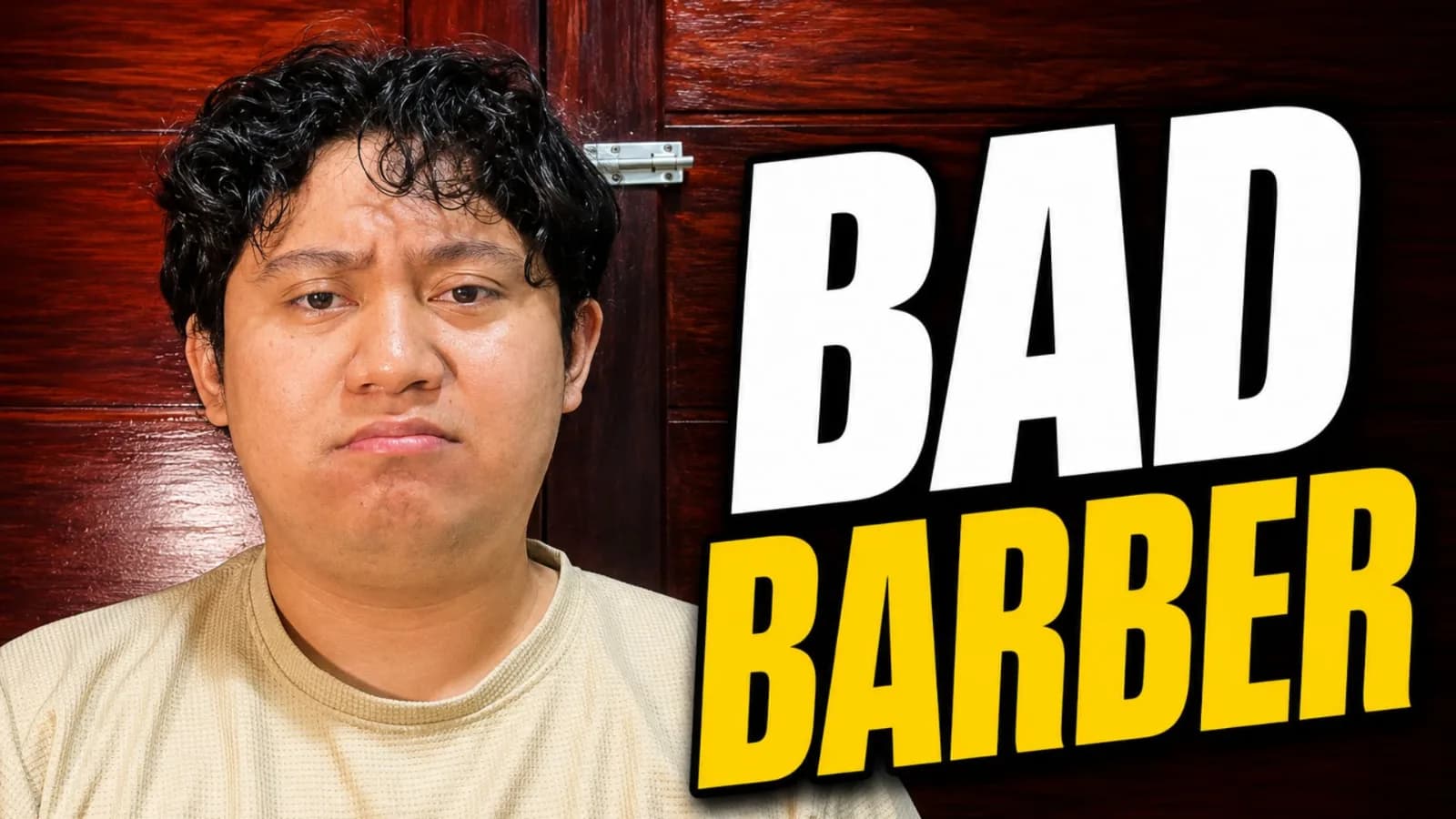
I hadn't had a haircut in months. Three, maybe four — long enough that every time I caught my reflection in the small mirror above the sink where I do my laundry (yes, my laundry area doubles as my only mirror right now), I'd wince a little. My hair had gotten thick enough that it was starting to look less like a style and more like a decision I kept postponing.
I'm still new to Laguna. New apartment, new area, and no idea yet where the good barbershops are. So I did what anyone would do — I asked around. Classmates, acquaintances, anyone who might know a decent spot nearby. And to be clear, I'm not one of those people who's traumatized by bad haircuts. I've had my share of questionable trims over the years and shrugged them off. I'll sit in almost any barber's chair without much hesitation.
But this time was different. This time, I walked away with a story I couldn't just shrug off.
The Morning I Finally Decided to Go
I don't even remember exactly what triggered it — whether it was an event I had to attend or just finally hitting my breaking point with how heavy my hair felt. What I do remember is waking up early after a night shift, specifically so I could get a haircut done before heading out for the day. That's saying something, because sleep is sacred when you work nights. I set an alarm, dragged myself up, and rode my motorcycle downtown to find a shop that was actually open that early.
I ended up near a well-known spot — the kind of place people mention when you ask where to get a decent, affordable cut in the area. Rates were reasonable, somewhere around a hundred pesos give or take. I wasn't picky. I was there because it happened to be open, not because I'd done any real research.
Two Barbers, One Bad Match
Walking in, there were only two barbers on duty. One was near the door, the other toward the back. The one by the door pointed me toward his colleague at the far end. That barber waved me over — still on his phone the entire time.
I sat down. He kept scrolling. I could hear the tinny sound of whatever game or app he had open, and once I got a better look, I realized what was happening: he was gambling. Actively, mid-shift, phone in one hand, scrolling through what looked like some kind of betting or card game interface.
He draped the cape over me, tucked in the tissue at my collar — one-handed, because the other hand was still occupied with his phone — and asked what style I wanted. I pulled up a photo on my own phone, a haircut I liked from a friend's wedding, and explained the details: not too trimmed on the sides because my hair doesn't sit well when it's too short, needs a bit of length to actually lay down properly.
"Copy," he said, and got to work. Phone propped up directly in front of me on the counter, still playing.
When "Skilled" Isn't Enough
Here's the thing — I know barbers get into a rhythm. I know they read the shape of your head and know instinctively where to taper and where to leave length. I don't doubt he knew what he was doing on a technical level. But watching him glance between my hair and his phone screen, watching him keep the game running the entire time, made something in me deflate a little. It didn't feel like I was getting his attention. It felt like I was squeezed into the gaps between his turns.
Then came the small talk — except it didn't feel small. He asked what I did for work. I gave the short answer I usually give people who wouldn't understand the nuance of what I actually do: "call center." It's easier than explaining bookkeeping, US clients, QuickBooks, and everything else that comes with running a virtual assistant business. He nodded, mentioned an acquaintance of his in a similar line of work who supposedly earned well but had gained weight from sitting all day. I laughed it off — "yeah, that's kind of the trade-off with remote work" — but the conversation had this undertone I couldn't quite place. Like he was fishing for something.
He kept glancing at his phone. Kept scrolling. Kept playing.
The Massage That Came With Strings Attached
Once he found out I worked night shift, something shifted in his approach. He slowed down. Got more deliberate, more careful with the details — like he'd suddenly decided I was worth the extra attention. And then he started massaging my shoulders, my back, my arms.
I'll be honest — it felt incredible. If you work from home, you know that specific kind of tension that builds up in your neck and shoulders from sitting hunched over a screen for hours. When he worked on my scalp, I could feel myself relax in a way I hadn't in weeks. The man was good. I won't take that away from him.
But then he said it.
"Ayusin ko lang yung masahe mo, sir, kasi baka mabigyan mo ako ng tip."
Just like that. Mid-massage. Out loud.
And that's when the whole experience soured for me.
The Difference Between Earning a Tip and Demanding One
I want to be precise about what bothered me here, because it's not that he asked for a tip. Tipping culture exists precisely because good service deserves recognition beyond the base price. If he'd just done a great job and let the quality speak for itself, I would have tipped him without a second thought — I always do when service genuinely impresses me.
What crossed the line was the way he said it. He wasn't letting his skill speak for itself; he was verbally cornering me into an obligation before he'd even finished the job. It's a subtle but important distinction: a tip that's earned through genuine service feels like gratitude. A tip that's requested mid-service, framed as something you now "owe" because of the effort already being put in, feels like being boxed into a corner you didn't choose to stand in.
I gave him what I normally give — the standard tip I'd give any barber for a decent cut. Not because I felt his approach deserved a reward, but because I didn't want to make a scene, and because, again, his actual skill wasn't in question. I relaxed, we finished up, I paid, and I left.
But I never went back to that shop.
Why This Wasn't Just About One Awkward Haircut
I've thought about this more than I probably should have for something as small as a haircut. But I think that's exactly why it's worth writing about — because it's small, and because it's the kind of thing that happens in countless service interactions every day, often without anyone questioning whether it's actually okay.
Here's what I keep coming back to: skill and professionalism are not the same thing. You can be excellent at your craft — genuinely gifted, even — and still lose customers because of how you make them feel during the transaction. Being on your phone while serving a customer, gambling during work hours, and subtly pressuring someone into a tip are three separate red flags that had nothing to do with his actual ability to cut hair or give a good massage. He was talented. He was also, in that moment, not someone I wanted to give my business to again.
If I owned that shop, I don't think I'd ever know this happened. The owner probably has no idea this kind of behavior exists on their floor, no idea that a customer walked out and quietly decided never to come back — not because of bad service in the technical sense, but because of how the service was delivered. Multiply that by however many other customers might have had a similar experience, and you start to see how much revenue can quietly walk out the door without anyone in charge ever realizing why.
The Takeaway, If You Run a Business
This is where I'd normally go deep into the specifics of SOPs and customer interaction policies — how to train staff on what's appropriate during a transaction, how to set boundaries around soliciting tips, how to make sure your team represents your brand the way you'd want it represented even when you're not watching. That's a conversation for another post, because it deserves its own space.
For now, here's the short version: if you have employees who interact directly with customers, it's worth asking yourself whether they know where the line is. Not just the line between good and bad technical work, but the line between earning goodwill and manufacturing obligation. A customer should always feel like tipping is their choice, made freely, because they wanted to reward good service — not because they were maneuvered into a moment where saying no felt awkward or rude.
I still don't remember that barber's face clearly. I don't know his name, and I probably never will. But I remember exactly how the interaction made me feel, and that's usually the part that sticks with customers long after the actual haircut grows out.
To know more about my services, writings — connect with me here — here's my website: https://www.kylenelsonomac.com/