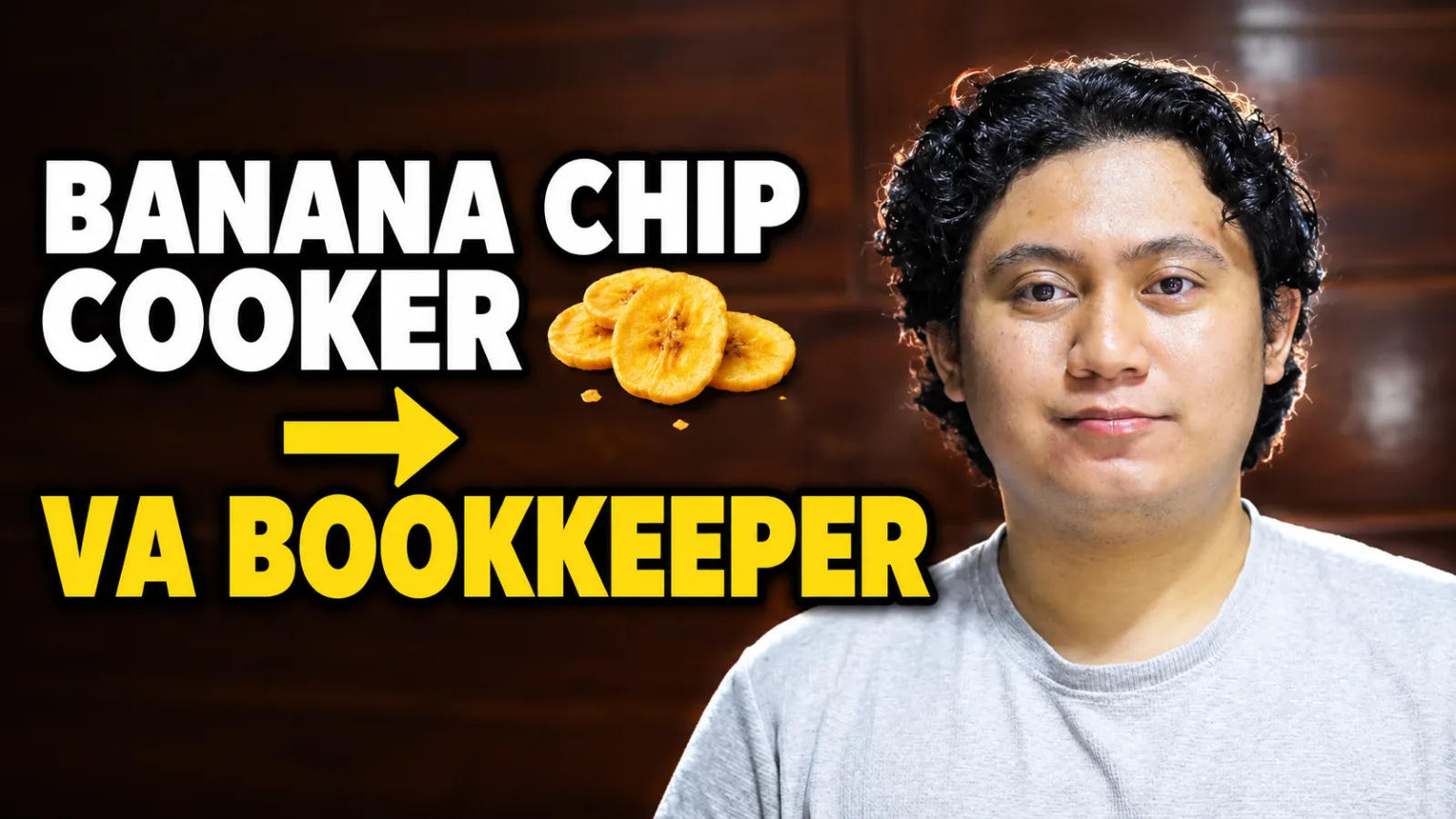
I've been a VA bookkeeper for almost five years now. But before the clients, before the QuickBooks certification, before any of it, there was one job that made everything possible.
It wasn't an accounting job. It wasn't even an office job.
I was a banana chip cooker.
That job paid for my very first training, and in a way I never expected, it became the reason I'm a VA bookkeeper today. If you have a full-time job right now and you're quietly planning to move into work-from-home or VA bookkeeping, this story is for you. Treasure the job you have. It might be the bridge you don't see yet.
Where It Started: Watching My Mother Carry Everything
My desire to earn my own money started right before the pandemic.
My father passed away when I was in Grade 9. From that point on, my mother raised my sibling and me on her own. She worked at a boutique owned by a churchmate, a general merchandise shop that sold everything from skincare and t-shirts to pants and basic home appliances. Being there exposed her to online suppliers and online posting, so she became a reseller of the same boutique she worked for. She'd take photos of the products, post them on her page and personal profile, add her markup, and sell.
Then the pandemic hit. I was in Grade 12 by then, and classes had gone fully online. My mother's online selling was what kept us alive. She started selling food too, from suppliers she'd met along the way. But let's be honest: the pandemic was a crisis. People lost jobs. Families struggled. We were one of them.
I saw, up close, how hard it was for her. Even when she tried not to show it. Even when she didn't want us to see.
That is what pushed me not to pursue accountancy in college at first. I didn't want to be a financial burden to her. So to cope with the weight I felt watching her carry the two of us, I started helping her sell. I told her, "Ma, I want to sell too, like you."
She said, "Sige. Here's what you do. Copy my captions and photos, post them on your profile or on Marketplace, and add your markup. I'll handle the delivery." (My mother is great on a motorcycle.) Or we'd have the customer pick it up directly from the supplier, and my markup would be sent to me through GCash.
That's where I first learned to sell. To talk to all kinds of people. To negotiate. To find more suppliers. And for the first time, I earned my own money. Not big money, but real money, and with zero capital.
The Push to Enroll, and the Long Pandemic Gap
As I was finishing senior high school, I could see how badly my mother wanted me to go to college. My girlfriend at the time had already enrolled, and she kept pushing me too: "Mag-aral ka na." My mother said, "Study. I'll support you. We'll work it out."
So I enrolled.
But enrollment kept getting pushed back. Remember how everyone said COVID would only last a month? Two years passed. Schools kept trying to bring back face-to-face classes, and kept failing, so the dates moved again and again. That meant a very long gap between senior high school and college.
And in that gap, I found the banana chip factory.
"You're Too Young for This Work"
A churchmate of mine worked at a banana chip factory, so I asked if they were hiring. The first thing she told me was, "You can't work there. You're too young, and you're not used to heavy work."
To be fair, I didn't look the part. Back in senior high, I was very fair-skinned and pretty thin. Totoy na totoy. Looking at me, you would never think I could handle hard labor, and banana chip production is hard labor.
But I told her, "No, I'm used to heavy work." My father was a banana grower, and he trained me in heavy lifting. Whenever there was construction, I helped out. I kept insisting until she referred me.
At the factory, I proved I could handle it.
I worked across almost the whole process. First, peeling: stripping the raw green bananas. Then slicing: the bananas get soaked in water to remove the sap, then dumped from a crate into a huge funnel where a machine with a large blade slices them, and you guide and lift the crates by hand. Then cooking, where I stayed the longest: the first fry. Then packing, where the chips are boxed and shipped to Davao for the second fry, where the sugar coating is added.
I lasted there. And I tried to study at the same time.
The Choice Between Work and Accountancy
I chose modular learning, because modular students could still join online classes, while online students didn't get modules. That way I'd have my modules and could still attend online classes whenever I had time. I studied at night. Sometimes I'd join the scheduled online classes for my accountancy subjects after work.
The first cluster was fine. It felt like a refresher of senior high school, and I was good at accounting back then.
Then the second cluster came: Financial Accounting and Reporting (FAR) and Intermediate Accounting. That's where I struggled. Not because I couldn't learn it, but because I was working more than eight hours a day, sometimes up to eleven, doing nonstop heavy labor. You come home exhausted. Are you still going to study?
I had to choose. Continue working, or continue studying.
I weighed it for a long time. My mother and my girlfriend both really wanted me to keep studying. I wanted to keep studying too. But I hated the feeling of having no money.
What would you choose, if you were in my place, watching your parent struggle to send you to school?
Accountancy is not a course you can do part-time. At least not for my brain, which I'd describe as having just enough brain cells. Accounting takes energy to learn. It isn't simple, especially once you hit complicated problems and advanced accounting. And it's even harder when your job is physically draining.
So I told my mother, "Ma, I'm going to stop studying for now. I'll work first, save up, and whatever God's plan is for me, I'll go back to school."
My girlfriend continued. I stayed as a banana chip cooker.
Haunted Every Single Day
That decision haunted me almost every day.
Since senior high school, I had been obsessed with accounting. It was my life. I had promised myself that my course and my career would be accounting-related. Whether or not I became a CPA, I wanted to be in accounting. That's how much I loved it.
And I had traded it for cooking banana chips.
I watched my batchmates move up, level by level. One day I told my girlfriend, honestly, sadly, vulnerably: "I don't know what I'll feel when I see our batchmates graduate. I can't even imagine my reaction."
There was nothing I could do about it then. So every day, I asked myself: What can I do to realign myself with accounting? Even as a cooker, what job opportunity could I find that's accounting-related, even without a degree?
I prayed, Lord, even if the pay is small. Even if I'm just an intern. Just let me have experience. Because I wanted it that badly.
The Search That Changed Everything
During the pandemic, "work from home" became the buzzword. Freelancing. Virtual assistants. Trainings and job opportunities flooded the internet (along with plenty of scams).
I didn't know VA bookkeeping existed yet. I only knew about general VAs, social media managers, video editors, media buyers. But one question kept nagging me: Is there a work-from-home opportunity related to bookkeeping or accounting?
So I searched it on Google: "Is there a work from home opportunity for someone who knows accounting?"
The results showed bookkeeping, accounting, accountant, virtual accountant, even virtual CFO.
So there IS work from home for this.
Then the next question hit me, because here in the Philippines, accounting jobs almost always require a degree. Accounting involves sensitive information, and companies don't hand that to people without credentials. So I searched again: "Is it required to have a degree if you want to be a work-from-home bookkeeper?"
Google's answer: No. You need accounting basics, the accounting software, and the standard accounting practices of the country you're serving. You can start from there and improve over time.
I felt alive again. I was still a banana chip cooker, but hope came back.
What do I have to lose? I had already dropped out of college. I knew basic accounting. And this was something I genuinely loved doing.
From there, the algorithm kept feeding me "work-from-home bookkeeper" and "VA bookkeeper" content. I searched YouTube. I fact-checked whether it was real. I joined communities. I learned that QuickBooks Online was what many clients used. Eventually, I wasn't just curious anymore. I was looking for training.
The Training I Funded with My Factory Salary
I researched everything about QuickBooks. I learned the difference between QuickBooks Desktop and QuickBooks Online. I even tried installing Desktop on my laptop, only to find out it required a purchase, that downloading a cracked version was risky, and that the interface was completely different from Online.
Then I found it: a QuickBooks Online for Accountants training from a page called VA Training Philippines.
I messaged their customer service again and again. "The training says 'for accountants,' but I'm not an accountant and I don't have a degree. I do know accounting, though."
They replied: "Sir, you can still join. The reason it's called 'for accountants' is that we want participants who already understand basic accounting, so we can focus on QuickBooks itself. You qualify."
I felt alive again.
The course cost almost ₱2,000. As a banana chip cooker, I had very limited funds. The work breaks your body, but the pay is small. I told myself, I'll use my entire 15th payday salary for this. When payday came, I paid right away through GCash.
The training ran for a week, about three hours a day. After my shift, I'd watch the recorded videos. On days I got off work early, I'd rush home to catch the live session so I could ask questions.
Because I already knew accounting, they could go straight into QuickBooks from beginner to advanced: accountant tools, reclassify, bank rules, and other advanced features I still use today. It sank deep into my mind. It all felt so familiar. The goal was mastery of QuickBooks Online navigation and, after that, becoming QuickBooks certified.
I was so excited every single day. Three hours felt like thirty minutes. Things finally made sense. And I thought: This is really it. This is for me.
Failing the QuickBooks ProAdvisor Exam
After the training, we got our QuickBooks Online Accountant accounts and attempted the QuickBooks ProAdvisor certification. I was still working at the factory.
I failed. Badly.
Back then, the ProAdvisor exam had multiple sections. If you used up the maximum number of attempts (I believe around five), your passed sections would reset and you'd have to wait months before trying again. I'm not sure if it still works that way.
I had failed two sections, and I had only two attempts left.
So I did something I had never done before. I set the exam aside and forgot everything that was in my head. Then I bought a notebook and a ballpen.
That might not sound like a big deal, but it is for me. Even now that I'm back in school, I never take notes. I bring a pen, borrow paper when I need to, but I never write notes. That's my attitude.
This was the first time in my life I bought a notebook to study.
I went back to day one of the one-week training. I wrote everything down. I drew QuickBooks in my notebook, almost word for word, every step that mattered. I took it seriously. For one week, I locked in. I woke up early to study. Note after note after note.
At that time, it never crossed my mind that I could create another account to retry. All I knew was: I have two attempts left. I prayed: Lord, if I don't get this certification, then this isn't for me.
On exam day, I was nervous. But it was open notes, so I used my notes. (Call me a cheater, but they were my notes.) There was a suggested time limit, but I didn't let it pressure me. I locked myself in my room and told my mother not to disturb me.
Back then, you had to finish all the sections before seeing the result. I honestly don't remember every detail anymore. What I remember is this:
I passed.
I shouted and shouted inside our house. "YES! Thank you, Lord!"
These days, a QuickBooks Online ProAdvisor certification isn't celebrated much. But five years ago, for me, it was huge. I had no degree. I had no experience. That certification was the only thing I could hold on to. It was the sign I had asked God for, that VA bookkeeping was for me.
I posted it on Facebook. I posted it on LinkedIn. Every year since, I've reshared it on my personal Facebook, because I still celebrate it.
Now, Lord, just experience. Just let me have experience.
The Accounting Job That Was Right There in the Factory
Here's what I did in the month after getting certified, before I resigned.
Picture the factory layout: when you enter the gate, the canteen and the office are on one side. Walk a little farther, and you reach the production area. The supervisors, quality assurance, and accounting people worked in the office, but they would come into production from time to time to do inventory, check attendance, and count the total output.
And remember, I was also a little bit of a businessman back then. I sold mobile load. So the accounting staff, QA, and my friends there bought load from me.
I asked our team lead, "Ma'am, do you know what accounting software they use inside?" She didn't know. Production team leads don't really care about office software. But she said, "Let's ask them when they come in."
One day, the accounting staff came to me to buy load. I asked, "Ma'am, what accounting software do you use in there?"
She said, "Oh, just QuickBooks."
What?! "Ma'am, I'm certified in QuickBooks!"
I asked if it was Desktop or Online. She wasn't sure. She'd just been trained on it directly, and she only encoded and encoded.
I felt alive again. Is this a coincidence? Did the Lord put me in this factory so I could transition into an accounting role right here?
Then I saw a notice from the manpower services: they were hiring for accounting.
The HR officer also bought load from me, so I told her, "Ma'am, I have something to tell you. The software they use inside is QuickBooks. I'm QuickBooks certified." I showed her my certificate and my training certificate.
She asked, "Are you a graduate? What's your college course?"
That's where I melted. "Ma'am, I don't have a degree yet. I'm a senior high school graduate."
She said, "Oh. Our requirement is a college degree. I'll think about it. But a degree is really non-negotiable for us."
It wasn't a total rejection yet, but I melted. Reality had been thrown at me: without a degree, you have no leverage.
I was so excited, though, that I pleaded: "Ma'am, even just try me for one month. Don't pay me. I just want to show you I know what to do. I just want to prove I deserve to be hired."
She said she'd think about it.
But I knew how people saw us in production. Many of my co-workers hadn't finished school. Many were dropouts, like me. I felt that's how she saw me too: just someone from production. Someone who peeled bananas, sliced them, cooked them, and packed them for Davao. I felt small. I felt like she didn't believe in me.
Week after week, I waited. She had said, "Kyle, I'll let you know."
Then she stopped coming to the office. The company was opening a new branch in the next town, and she was handling HR and manpower there. I waited anyway, because I wanted to offer her load again, just to have the chance to follow up. She never came back.
So I asked our supervisor for her number and called her. "Ma'am, it's Kyle. Is there any chance at all, even just as an intern, or a trial as an accounting assistant there in the office?"
She said, "Kyle, I'm sorry I didn't update you. I really tried to convince our boss to push through with your application. But they really want someone with a degree. I'm sorry."
That's where I broke.
I went to the CR and cried. Then I went back out, because the bananas would burn. I was the cooker. Then, when I could, I'd step away again, go back to the CR, and cry again.
It was my first rejection for the work I wanted so badly: accounting-related work.
Resigning, and the Two Months of Rejections
About a month later, I resigned.
I prayed for an accounting-related job, and there was clearly no chance of that happening there. I couldn't see a future for myself in that company.
My last pay gave me a little money to keep me going while I looked for something new.
Two months passed. Rejection after rejection. I applied here, I applied there. No degree, no experience. What do you expect? It's fair. No direct client, no agency.
So to keep from forgetting what I had learned, I started making content. If you scroll back to my oldest YouTube videos, you'll find QuickBooks Online tutorials in English. There were two reasons for that.
First, recruiters kept telling me, "You need to improve your English. Communication is crucial for a VA bookkeeper." Those tutorials were my way of practicing.
Second, they were my way of refreshing everything I knew about QuickBooks Online and accounting.
I shared those videos in accounting communities and Facebook groups, and on LinkedIn. And something I never planned happened: people started commenting and asking me for help.
The Irony of the Pandemic Hiring Boom
During the pandemic, a lot of VAs got hired without knowing what to do. Many foreign clients hired Filipinos who had local accounting experience, assuming they already knew QuickBooks Online or how to be a VA bookkeeper.
That was a wrong assumption. The difference between the US and the Philippines is huge. US bookkeeping is largely paperless, with bank feeds connected straight into the software. Philippine accounting, especially back then, was very manual and paper-based.
So people with local accounting experience landed clients but didn't know what to do, and they ended up coming to me.
It was ironic. They had clients but didn't know what to do. I knew what to do but had no clients.
I taught them anyway, for free. Share your screen, I'll show you, I'll explain it. It was how I kept learning and building connections.
My First Client Came Through Someone I Taught for Free
One of the people I taught had a full-time job in accounts receivable. Like the others, he got hired because of his local experience but didn't know what to do. I taught him for about a week, one of the longest I'd ever helped anyone, because everything was new to him.
Then one day, he said, "Kyle, I really can't do this. My client is in a rush, and you already know my client's QuickBooks. I'm under too much pressure. I'll just give my client to you."
I said, "Are you serious? This is your first client. Don't. Let's work on it together. You can do this."
He said no, he'd give it to me. I said, "If you're sure, why not?" I honestly thought he wasn't serious. He asked for my WhatsApp, and I forgot about it. We stopped having sessions.
Three days later, he messaged me: "Kyle, I've turned you over to the client. Expect a call anytime today."
The next morning, very early, WhatsApp rang.
"Hey, is this Kyle?"
"Yes, this is Kyle speaking."
The client explained that I'd been referred by my friend. He didn't interview me. He didn't ask for my résumé. He didn't run a background check. He only said:
"Kyle, my business is real estate. I do rentals and construction. My only question for you is: do you know how to use QuickBooks Online?"
I said, "Yes. I've been guiding this guy to fix your books."
"Okay. You can start as soon as possible."
That became my first client. He stayed with me for the first two years of my career.
It was a miracle. The referral bypassed everything I was afraid of: no degree, no experience, all my self-doubt. It connected me to a client who only asked if I could do the work. And I could, because I had already been doing it for free.
How God Reversed the Order of My Life
From there, things moved in a way I could never have planned.
I started as a work-from-home VA, which wasn't always stable. But because of that hands-on VA experience, I got accepted into corporate roles, including accounts payable work. Because of that solid corporate experience, I got accepted into VA agencies, the ones with very strict requirements. And once my career had proper cash flow, I went back to school.
Five years ago, I couldn't study because of financial constraints. Today, my work as a VA is what pays for my education. I'm now a student in Laguna, far from my family, supporting myself. I'm Bisaya, a Bisdak na Bisdak from the Davao region. How did I end up studying in Laguna? Only by God's grace.
Usually, the sequence goes: graduate first, then start your career, then look for work. My life went in reverse. I started as a VA, gained corporate accounting experience, got hired by demanding VA agencies, and then God sent me back to school.
So my career as a VA bookkeeper isn't about my qualifications or how good I am. It's God's grace and God's miracle.
From Banana Chip Cooker to VA Bookkeeper
Looking back, I'm still grateful for that factory.
If I had been hired as their accounting assistant, I probably wouldn't be a VA today. I would have gotten comfortable. Yes, I finally have an accounting-related job. Becoming a VA would never have crossed my mind again.
That rejection was a redirection: That's not for you. Go be a VA.
A banana chip cooker job, impossible and completely unrelated to accounting, was my first work, the one that funded my training and helped me become a VA bookkeeper today.
If you have experience but are struggling to find clients, or you're a high school graduate thinking a client is impossible for you, ask yourself where possibility really begins.
It begins with desire. It comes out of your mouth as prayer. It settles in your heart. Then it becomes faith, and faith is the evidence of things you want to happen even when you can't see them yet, even when they look impossible.
My prayer back then was simple: Lord, any job, as long as it's related to accounting. He gave me VA bookkeeping.
Is anything too hard for the Lord? I'm a living testimony that nothing is impossible with God. And if the same God who made all of us answered me, why not you? God has no favorites.
Lessons for Aspiring VA Bookkeepers
If you're planning to move from a full-time job into VA bookkeeping, here's what my story taught me:
Treasure your current job. It can fund your training, just like a banana chip factory funded mine.
Search for the real requirements, not the assumed ones. I assumed I needed a degree. The real requirement was basic accounting knowledge, the software, and the standards of the country you serve.
Invest in focused training. One week of QuickBooks Online training, paid with one payday, changed my direction.
When you fail, change your method. I bought a notebook for the first time in my life, and that's how I passed my ProAdvisor exam.
Keep practicing in public while you wait. My tutorial videos improved my English, refreshed my skills, and connected me with the person who referred my first client.
Help people without expecting anything back. My first client came from someone I taught for free.
Direct clients may care less about degrees. Agencies and BPOs often require one. Many business owners just want to know if you can do the work.
Questions from the Live Session
Where did you find your first direct client? Through a referral, from someone I had been teaching QuickBooks Online for free.
Did you have an accounting background before bookkeeping? No professional accounting background. I studied accounting in senior high school and briefly in college before stopping, but I had no work experience in it.
Why did you choose bookkeeping out of all the niches? In senior high, I discovered I was good at accounting. I was supposed to take my NC III certification when I graduated, but the pandemic stopped it. I never planned to be a VA bookkeeper specifically. My only prayer was for any job related to accounting, and God gave me VA bookkeeping.
Which software have you used with clients? Mostly QuickBooks Online. All my clients have used QBO. I'm also familiar with Wave and Zoho, but I've never had a client on Xero.
Do you recommend bookkeeping to someone with no experience but who's willing to learn? As long as you're willing to learn, you can try almost anything, not just bookkeeping. I don't recommend it to everyone, but if you really want it, what's stopping you?
How do you categorize a customer payment received before the items are restocked? The payment is a posting transaction: real money has moved, so record it as soon as possible. The more proper treatment is to record it as unearned income (a liability, because you still owe the customer the product), then reclassify it to the actual sale once the stock arrives and is delivered. The shortcut is to record the sale right away. QuickBooks will let inventory go negative and it turns positive once you restock, though that isn't ideal. Contrast this with non-posting transactions like estimates (quotations) and purchase orders, which don't affect your financial statements. In the end, follow your company's process and what your accountant tells you.
Start Your VA Bookkeeping Journey
If you're aspiring to become a VA bookkeeper, or you already have skills but struggle to land your first client, I teach the step-by-step path inside my programs. Some lessons can't fit in a single YouTube video. They have to be taught in sequence, because you can't understand step 3 without step 2.
My free course on understanding business context goes deep into the logic behind business departments and the sub-departments of accounting, the big picture most basic trainings don't cover. Signing up also gives you access to our Discord community, where you can talk to me directly.
👉 Join my programs here: https://programs.kylenelsonomac.com
To know more about my services, writings -- connect with me here --- here's my website: https://www.kylenelsonomac.com/
Faith without action is Fiction.